Cheat-Seeking Missles

Monday, June 23, 2008

Hard Times, Courtesy Of The Greenies

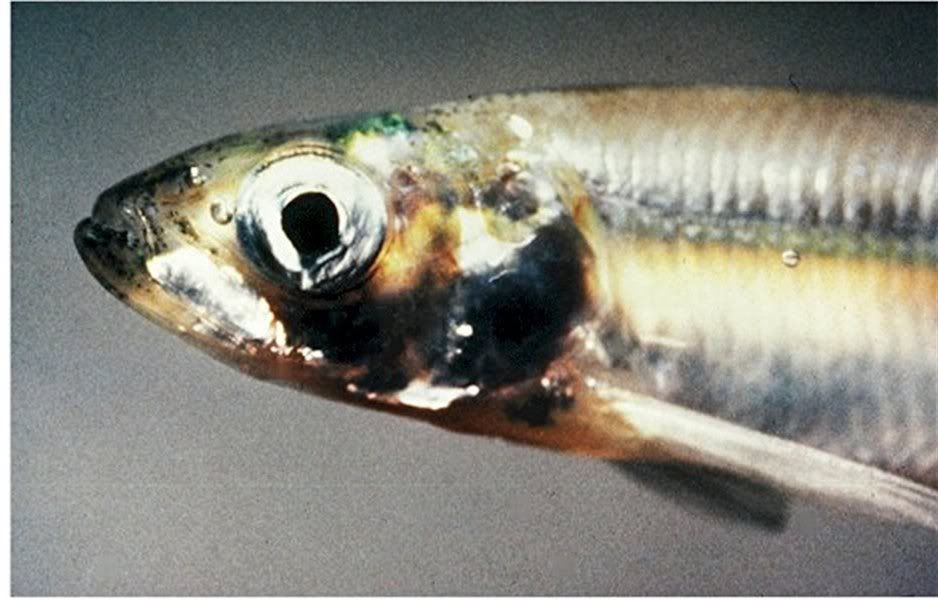
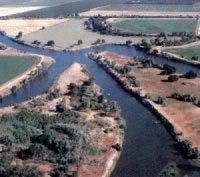
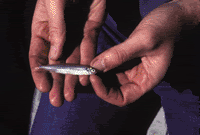
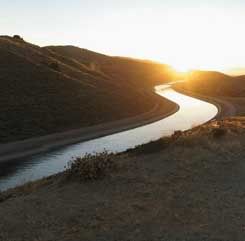
Water that used to flow from California's delta southward to irrigate the nation's breadbasket fields of the San Joaquin Valley, and on to slake our thirsts in SoCal, now stays in the delta, thanks to the Center for Biological Depravity's ... uh, Diversity's ... lawsuits to protect the Delta smelt fish.

When stuff like this happens, it causes what is generally referred to as "results." For starters, the California Department of Water allocation is now at 35 percent of normal, down from the routine 50 percent of normal, which is, as you probably guessed, half of what people would like to get.

And that has its own results. From the Bakersfield Californian:
Faced with too little rain and restricted pumping to protect an endangered fish, farmers and ranchers in and around Kern County are facing tough choices. In a typical year, 850,000 acres are irrigated, according to the Kern County Water Agency.

This year, about 45,000 of them will be idle at a cost of $46 million. In addition, 100,000 acres will be “underirrigated,” causing a $59 million loss.

“It’s a catastrophic crisis of historic proportions,” the agency’s general manager, Jim Beck, told the Kern County Board of Supervisors Tuesday before the board passed a resolution declaring “a potential disaster condition exists throughout Kern County.” ...

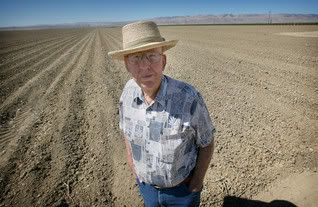
Rancher Kenneth Twisselman is worried. He works on Temblor Ranch in western Kern County, raising cattle on 50,000 acres. ...

Twisselman declined to divulge specific numbers, but said the drought forced the ranch to halve its herds from last year by slaughter or relocating them to pasture in Oregon or further north in the state.

“We have very few cattle, and very little grass,” he said. “And of course a lot of the corn has gone to ethanol, not feed lots.”
That translates as higher food costs, brought to you by the Greenies. Add it to the higher fuel costs, also brought to you by the Greenies (who are responsible for that portion of higher costs attributable to low domestic production and shortage of refining capacity), and higher housing costs (in CA between one-quarter and one-third of the cost of a home is its regulatory burden).

It seems a key platform of the Greenies is for us to have less green in our wallets ... and on our fields.

Labels: ,

Sunday, June 01, 2008

Sunday Scan

Thanks, Mates!

As expected, Australian PM Kevin Rudd, who won his seat following promises to bring Aussie troops home from Iraq, has ended combat operations so withdrawal can begin. The Aussies were stationed in the south, particularly around Nasiriyah, which has seen its share of violence.
Troops held a ceremony Sunday that included lowering the Australian flag from its position and raising the American flag instead over Camp Terendak in the southern Iraq city of Nasiriyah.

"We have to praise the role of the Australian troops in stabilizing the security situation in the province through their checkpoints on the outskirts of the city," said Aziz Kadim Alway, the governor of the Dhi Qar province. (AP)
Like the dependable ally they are, the Aussies aren't just pulling up and running home. Several hundred other troops will remain in Iraq in security and liaison roles, and Australia will leave behind two maritime surveillance aircraft and a warship to help patrol oil platforms in the Gulf.

There were no Digger fatalities during their five-year deployment. Six were injured, one seriously.

One Man, One-Half Vote

Dumb Democrats. The party that railed so vociferously about citizens deprived of votes in 2000 and 2004 has decided voters in Michigan and Florida, who had nothing to do with when their primaries were held, are only half-human. And many Dems are PO'd, as this clip demonstrates:


The agreement, termed "politically astute" by Walter Shapiro in Salon, is anything but. It won't end the acrimony, as the Clinton camp is talking lawsuits and supporters are threatening to sit out the election. Worse, it avoided the simpler, more politically astute solution: Seating all the delegates and punishing the state party leadership. All the delegates should have been seated (delegates of departed candidates could have been redistributed mathematically), and the to states' parties' leaders could have been dinged any number of ways: monetary fines, stripping of leadership roles, whatever.

The Dems punished the wrong people: The People. The Hacks should have been punished. But the Hacks are for Obama this year, so the party of the people threw the people overboard. The DNC and Obama deserve all the rancor and defections the agreement generates.

George Will Calls For Carbon Tax

I normally would rail against a conservative calling for a tax -- especially a tax to stop global warming, which we know at the outset will fail to accomplish its goal. But in this case, Will's got a point that's worth making: Given a choice between a black hole into which money will be poured for no purpose (the Lieberman-Warner global warming bill, which will be debated in the Senate this week) and a clear, visible and straightforward tax on carbon fuels, the latter is more preferable by far.

Could we have neither, please? Maybe, but given the great excuse global warming provides government to increase its power and tax its citizens, I thought I'd present the crux of Will's argument:
With cap-and-trade, government would create a right for itself -- an extraordinarily lucrative right to ration Americans' exercise of their traditional rights.

Businesses with unused emission allowances could sell their surpluses to businesses that exceed their allowances. The more expensive and constraining the allowances, the more money government would gain.

If carbon emissions are the planetary menace that the political class suddenly says they are, why not a straightforward tax on fossil fuels based on each fuel's carbon content? This would have none of the enormous administrative costs of the baroque cap-and-trade regime. And a carbon tax would avoid the uncertainties inseparable from cap-and-trade's government allocation of emission permits sector by sector, industry by industry. So a carbon tax would be a clear and candid incentive to adopt energy-saving and carbon-minimizing technologies. That is the problem.

A carbon tax would be too clear and candid for political comfort. It would clearly be what cap-and-trade deviously is, a tax, but one with a known cost. Therefore, taxpayers would demand a commensurate reduction of other taxes. Cap-and-trade -- government auctioning permits for businesses to continue to do business -- is a huge tax hidden in a bureaucratic labyrinth of opaque permit transactions.
Cap and trade is often presented as a free market solution. It is anything but. Citizens concerned about the fragile economy and the failure of government to reduce spending should regale their Senators with letters and calls opposing the bill. For me and other Californians, our useless Barbara Boxer has already come out in strong support of the bill. Natch.

Could The Iranians By Lying?

Lying Iranians?! Say it isn't so! Those who oppose harsh action against Iran's nuclear program stand ready to believe that Iran is pursuing nukes for purely peaceful energy-producing reasons. Then why this?
Iran Building 7 Refineries to Hike Capacity

TEHRAN (FNA)- Iran is constructing seven refineries in an effort to boost its crude and gas refining capacity by more than 1.5 million barrels per day (bpd), a senior oil official said Saturday.

"The construction of seven refineries has started with the investment of 15 billion euros ($23.22 billion)," MNA quoted Aminollah Eskandari, a director of the National Iranian Oil Refining and Distribution Company (NIORDC) as saying.

"About 1.56 million barrels will be added to the country's capacity to refine crude oil and gas derivatives," he added.
Investing $23 billion of an economically depressed nation's revenues in power plants it wouldn't need if it had a nuclear power grid seems even madder than what we've come to expect from the Tehraniacs.

Too Little, Too Late

Barack Obama has left Trinity United -- one month after Rev. Wright accused the prez wannabe of distancing himself from his true beliefs for political reasons and a week after Michael Pflegar exhibited some of the most flagrant racism in recent time from the Trinity pulpit. Here's his typically over-long and elegant statement:


In it, Obama blames the media for what's happened:
But it's clear that now that I'm a candidate for president, every times something is said in the church by anyone associated with Trinity, including guest pastors, the remarks will be imputed to me, even if they totally conflict with my long-held views, statements and principles.
He accuses news organizations of harassing members, which is warranted because pack journalism is an ugly thing. It took them a long time to wake up to Rev. Wright, but now that they're awake, there's no moderating them.

Obama said he's leaving the church in part to protect the parishioners from the media onslaught -- "That's just not how people should have to operate in their church." -- but he never says anything about protecting the American people from the crazy, racist, hate that is the stuff of sermons at Trinity.

He has "separated" himself from those teachings, but he has never sufficiently condemned Wright and his teachings for what they are: racist hatemongers.

Water, Water, Not All Around

The other CSM writes (via Environmental News) about water as the next oil, and they've got it half-right. We can survive without oil, but not without water -- so a massive water shortage will bring suffering, war and death.
Cyprus will ferry water from Greece this summer. Australian cities are buying water from that nation’s farmers and building desalination plants. Thirsty China plans to divert Himalayan water. And 18 million southern Californians are bracing for their first water-rationing in years.

Water, Dow Chemical Chairman Andrew Liveris told the World Economic Forum in February, “is the oil of this century.” Developed nations have taken cheap, abundant fresh water largely for granted. Now global population growth, pollution, and climate change are shaping a new view of water as “blue gold.”
Socialists are taking note:
“We’re at a transition point where fundamental decisions need to be made by societies about how this basic human need — water — is going to be provided,” says Christopher Kilian, clean-water program director for the Boston-based Conservation Law Foundation. “The profit motive and basic human need [for water] are just inherently in conflict.”
Some readers might be surprised that I agree with the socialists on this one. In 1995 we helped preserve a local, public water district fight off a take-over attempt by a private water company. Our research on that case showed that private water companies charged more than public agencies and didn't invest as much in infrastructure.

Plus, public agencies are better suited to fight off challenges from whacked-out environmentalists, who continue to attack new water infrastructure projects despite mounting evidence of the need to address global water shortages.

Labels: , , , , , , , , ,

Saturday, April 12, 2008

"No Water, No Development?" No Thinking Here.

If things go according to plan, tomorrow's LA Times letters section will carry a brief letter from me responding to an LAT editorial that ran last weekend, No Water, No Development.

Because letters to the editor are necessarily brief, I decided to spend some time today to do a more complete fisking of the editorial -- even though many of my readers may not find this overly interesting. I do because my business handles public affairs assignments for land developers and water districts.
As background, supplying enough water to all the folks who like calling SoCal home has always been a dicey affair at best, and it's getting worse.
  • California's population is growing fast -- it's expected to grow from its current 28 million to 38 million by 2030 -- and more mouths need more water.
  • There's been a prolonged drought in the Colorado River basin, along with a lot of growth in Arizona, and that's put pressure on our Colorado River resources.
  • The Sierra snowpack's about average this year, but this is the first time in a few years that it has been, so that supply source is not too reliable.
  • Aquifers need replenishment they tend not to get in dry years, so they're getting over-drawn.
  • Global warming advocates read their tea leaves computer models and forecast hotter, drier weather for SoCal.
Then there's the Greenies. Strip it all away, and their core mission is to stop the growth of the human presence on the planet, and if possible, dial it back some. They've discovered that water is one powerful way to do this. As Kieran Suckling, founder of the environmental litigation mill Center for Biological Diversity put it in a 1998 interview with Range Magazine,
Walley: "But what about those people who are suffering during this change?"

Suckling: "As I say, it is not a simple thing. We have entire communities that have grown up in this system of land-based government subsides. To change that is not a painless thing."

Walley: "You, are creating rural refugees!"

Kieran's ego finally shows, his speech picks up speed and emphasis: "It's more than rural. I'm dealing with the Grand Canyon, Hoover Dam and Los Angeles. Thirteen million people are used to getting their water this way, I say that's great, but we are going to show them a different way to do it!"

Walley: "You are forcing change on society and you are aware of it?"

Suckling: "Yeah! Isn't that what an activist is! What do you think an activist is? We change society!"

Walley: "Can't you do this in a humane and gentle way?"

Suckling: "It is sad, but I don't hear you put that in a direct relationship to the effect on the land. I hear you talk about the pain of the people but I don't see you match that up with the pain of the species."

Walley (dumbfounded): "What?"

Suckling: "A loach minnow is more important, than say, Betty and Jim's ranch-a thousand times more important. I'm not against ranching, it is a job. My concern is the impact on the land."
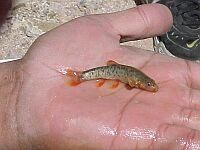
A loach minnow is a thousand times more important than Betty and Jim's ranch -- not the loach minnow species, but a single loach minnow.

Backing up this extreme belief with litigation, the Center used the Endangered Species Act to sue to stop the pumps that bring water to SoCal from the San Joaquin/Sacramento Delta, our primary water source. They triumphed, and the result is a 30% reduction in the amount of water coming from NoCal to SoCal.

The fix is a re-tooling of the Delta, which it needs if it is going to survive its current ecologically tenuous condition. Combined with that would be a canal that would bring water south without impacting the Delta -- a proposition the Greenies are fighting tooth and nail, natch.

Against that background, the LAT opined that because water is in short supply, development should stop in the suburbs.
During the 20th century in Southern California, city founders made a religion out of building bounteous -- and sometimes boundless -- suburbs in the most unlikely locations. They assumed that the water their new communities needed to thrive would somehow flow to them.

For the most part, if they made their claim early enough, they were right. Because the state and federal governments poured billions of dollars into dam and canal systems that carried water over vast distances, past far-flung burgs, engineers could almost always find a way to get a little more of it to thirsty towns. In tract after tract, water followed development, rather than the other way around.

Left unsaid in this little history lesson is that there was no greater champion of these programs than one Harry Chandler, the publisher of a little rag called The Los Angeles Times. He had the good sense to realize that if he was ever going to have a world class media empire, he was going to have to get water to LA.
In the 21st century, this ethos of expansion must come to an end. ...

It's a matter of common sense: It is time for development in California to follow the water. Even as our state continues to grow, sprawl can no longer be our birthright. Hydrologically remote regions cannot depend on new sources of imported water for human needs, much less for verdant lawns.
The statement is absurd. If we are to follow the water, then all of the development in California would be along the northern coast, in the northern Central Valley, and in the Sierras -- all of which are sparsely populated.

"Follow the water" is an utterly ridiculous concept also because we have the capacity and infrastructure to move water. Any development that is near existing water infrastructure -- say the city of LA in its semi-arid desert environment -- is as well situated, if not better situated, than one along a natural water source.

Calling for an end to suburban development to fix our water problems is no more a solution than would be a call to have the clouds drop more rain. Neither is realistic.

The LAT then goes through a three-paragraph exercise in diminishing the consequence of environmental and anti-growth laws it lobbied hard for itself. Thanks in part to the LAT's support, we now have laws in CA that require new development to prove that there is a 20-year supply of water sufficient to meet the community's dry weather demand.

This water can't be "paper water," i.e., contracts for water that isn't there; it must be provable as real water that isn't committed elsewhere. Yet the LAT forgets what it lobbied for:
Individual water districts generate the estimates. And some of these districts, in preparing reports for land-use planners, may rely too heavily on "paper water," flows that exist in legal allocations but aren't really on hand and may never be. As one former state legislator explains, "If people point to paper water, there's always enough for everybody."
But that's already been litigated, and the case law says the water has to be real. Water districts know this and know they will be sued if they allow development for which there isn't sufficient water, so they're serious about their water management plans.

Still, the LAT is negative:
Put bluntly, it makes little sense to depend on new water imports -- even if they "exist" as allocations -- when planning thousands of new homes in an isolated region. But depending instead on more secure local water supplies -- responsibly managed groundwater, gains from conservation, wastewater recycling and reuse -- is anomalous to California culture and will be a hard sell.
It is correct that relying on the Colorado River aqueduct and the State Water Project for new water imports isn't wise; the Hell has been allocated and litigated out of that water.

But what is this about responsibly managed groundwater, conservation and recycled water being a hard sell? The LAT simply does not know what it's writing about; it's making things up to create dread instead of optimism.

The dread comes from a fundamentally negative view of authority, which is pretty much a prerequisite for being an editorial writer.
Critics of building-friendly local governments frequently complain that water and land-use officials are controlled by developers, who have long been enthusiastic contributors to political campaigns. Whether that is true or not, it's almost certainly the case that California water agency culture is loath to say no to developers for a less-pernicious reason: Water districts are in the business of delivering water to local communities -- they don't see their job as determining water use policy -- and they don't like to say no to their customers.
If developers are so powerful, how come the homebuilding industry is one of the most heavily regulated in the country? When I speak on the subject, I usually start with the line, "Did you know it's easier in California to get permission to cut open someone's chest and stick a new heart in there than it is to get permission to build a house?"

Builders' whims are summarily crushed by the Endangered Species Act, the Clean Water Act, the Clean Air Act, the environmental quality acts of the federal government and various state governments, and regulations that require no runoff to leave construction sites, no grading during bird nesting season, no construction noise near nesting birds, strict building limits in fire zones, and that they fund roads, parks and schools.

Clearly, the idea that developers buy influence has plenty of proof against it and precious little for it.

And as for water districts, their mission is to provide a reliable source of safe water and an environmentally sound treatment of wastewater; it is not to grow. They have done wondrous things to account for growth, applying specialized engineering expertise creatively to bring water to people who need it, and to conserve it as much as possible.

In district after district throughout California, an emphasis on conservation and water recycling has allowed them to meet growing demand with the same amount of water. That goes for LA too, by the way.

But the LAT thinks it's all a wasteful game, especially when it comes to how the editorial writer thinks we should live; not with the suburbs' safety, cleanliness and recreation, but as the editorial writer him/herself no doubt lives, in a dirty and dour urban setting that oozes with "more green than you" snottiness. (More in a bit on why that's false snottiness.)
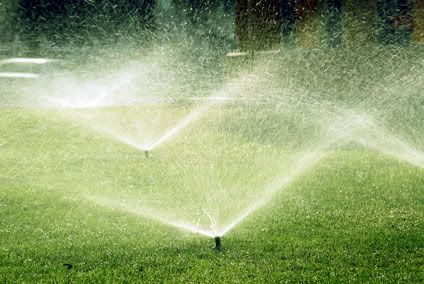
The editorial wants us to "follow the water" to these environments, shunning the suburbs because they have, horror of horrors!, lawns.
Even as our state continues to grow, sprawl can no longer be our birthright. Hydrologically remote regions cannot depend on new sources of imported water for human needs, much less for verdant lawns.
What silliness. First, there is no development in hydrologically remote regions. If there's an aqueduct or pipeline serving an area, it's not hydrologically remote. That goes for downtown LA, which steal its water from the Owens Valley and pipes it down to what was a rather hydrologically remote area.

Second, let's look at what's going on with those "verdant lawns."

First, of course, they get played on and lived on, and they help diminish the asphalt heat island effect of the city. But more than that, they are watered in ways the LAT feels is a "hard sell," but is not.

California’s water providers and community developers are far ahead of the Times in recognizing the water shortage and creating solutions, and many of these solutions focus on landscape irrigation. In fact, solutions the Times refers to as “potential” already exist, thanks to the cooperative efforts of water districts and land developers.

For example, we helped win approvals for a new planned community that tripled the size of the town of Calimesa, on the eastern edge of the LA metropolis. The developer worked with the local water district to receive permitting for a water recycling plant that will deliver reclaimed water to the front yards of homes, where it will be used for irrigation.
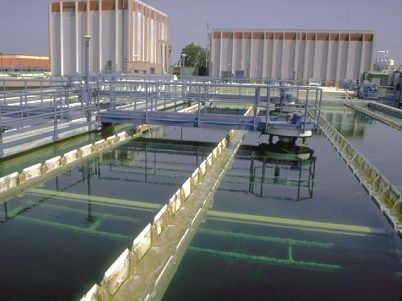
In South Orange County, both the Irvine Ranch Water District and Santa Margarita Water District (the county’s largest and second largest) have been recycling water and using it for irrigation since the 1970s. At IRWD for example, recycled water:
  • Irrigates 5,650 acres of parks, golf courses, school playfields, athletic fields, and many common areas,
  • Irrigates over 1,000 acres of crops,
  • Is used in industry, where one application at a carpet mill saves 500,000 to one million gallons of drinking water per day,
  • And now is being introduced into office buildings for toilet flushing.
SMWD, which also provides millions of gallons of recycled water a year for irrigation use, recently launched a program that captures urban runoff and recycles it for irrigation use. Its runoff capture facility near Dove Canyon not only makes about 100 acre feet of water available for irrigation use, it also has successfully eliminated much of the environmental damage the runoff was causing in the Starr Audubon Ranch, a nature preserve.

Innovation like this is happening all over California. Districts in the Central Valley with brackish groundwater are putting in desalters. Orange County just launched a toilet-to-tap program which required no "hard sell" to area residents because it's safe and will protect our aquifer. And on and on.

To the LAT, this innovation appears to be a thing of the future, something speculative, something not to be counted on. They would rather mandate how we live:
Californians' devotion to the easy suburban lifestyle (or at least, the easy suburban lifestyle as we know it). Thirty-nine percent of residential water use in California occurs outdoors, mainly when homeowners water their lawns. One way to secure "additional" water for growth is to cut yard sizes and impose landscaping restrictions on new and existing neighborhoods.
Apparently the LAT hasn't toured a model complex lately and seen the small yards, the common areas landscaped in drought-tolerant plants, and the sophisticated irrigation systems that measure ground moisture and only water as necessary.

No new regulations are required to accomplish this. Land prices have forced the private sector to respond with smaller yards, the environmental review process brings in water conservation methodologies, and the regional water quality control board mandates runoff controls, so landscape is irrigated sparingly.

But the LAT knows none of this. The editorial writer sits in downtown LA, surrounded by concrete and asphalt, and thinks the worse, as he/she should, because the environment there is the worst. Buildings are stuffed with inefficient toilets and fixtures. There is no runoff control. There is no recycled water. There is no toilet to tap program. There is infrastructure that's undersized and in need of major upgrading -- and we're supposed to move there?

Surrounded by the urban stupidity that is LA, the writer lashes out at the suburbs in some sort of tribal battle of urbanites against suburbanites. Sorry, though; we're not picking up this club because there's a better, two-fold solution.

First, we need to address the infrastructure issue with bonds that will fix the Delta and provide new conveyance and storage systems. Second, we must continue to let people choose where they wish to live, and let water districts and developers respond to existing conditions and regulations with ever more innovative approaches to acquiring and conserving water.

Just because the LAT says we need a state-controlled system that subjugates free will to the whims of urbanists doesn't mean we have to be so thick-headed and so uninnovative as to follow them.

Labels: , , ,

Friday, April 11, 2008

Great Moments In Branding

We've been doing some water district research here at the shop and came across what I'm sure it's a fine, public-spirited agency ... but there's no doubt it's one that's a bit clueless about branding.

Their name: The Anderson-Cottonwood Irrigation District.

Their url: www.acidwater.org

Yum. Pour me a glass!

Labels: , ,

Sunday, December 16, 2007

Sunday Scan

Al Qaeda No Big Deal

Let's not overblow this whole al Qaeda thing, shall we? So says the retired (Thank God!) top adviser on terrorism to the British government, Richard Mottram. The Observer reports:
Britian's outgoing intelligence chief believes there is a danger of exaggerating the threat posed by al-Qaeda at the expense of equally significant security issues, such as global warming.

Sir Richard Mottram, who has just stood down as Permanent Secretary in charge of Intelligence Security and Resilience, the body that advises the Prime Minister on the country's response to emergencies, will use a lecture this week to call for individual citizens to play a new role in combating the risks associated with increasing globalisation.
I have to say I do like "Relilience" bit. Dept. of Homeland Security and Resilience? Nah. Half the country wouldn't understand the meaning.
There was a danger, he said, of over-emphasising the spectre of international terrorism, which could play to al-Qaeda's advantage and divide communities.

'What we shouldn't do is play into al-Qaeda's hands by exaggerating the extent and nature of the threat they present globally. This focus is not smart when it comes to dealing with people who are trying to make us think that they are the greatest threat.'

Instead Mottram ... said there was a need to understand the potential impact of a range of strategic risks, of which terrorism was just one. He identified global warming, flu pandemics, the emergence of rogue states, globalisation and its impact on power balances, global poverty and its impact on population movement, energy security, the proliferation of weapons of mass destruction and serious and organised crime as similarly significant problems.
Yes, let's be careful to keep our troops handy in case we need them to fight global warming, globalization and poverty!

Please, Mottram, let's acknowledge that different problems have different solutions and attentiveness to al Qaeda does not preclude attentiveness to the others.

Clarity In Des Moines


Nice town, Des Moines. Figured in my meeting of Incredible Wife. Long story. But here's a short story, from today's editorial page of the Des Moines Register:
“With dissension at home and distrust abroad, as American troops continue to fight wars on two fronts, the times call for two essential qualities in the next American president,” the Register’s editorial board concluded. “Those qualities became the paramount considerations in making endorsements for the Democratic and Republican nominees in the 2008 Iowa caucuses.

“The times call for competence. Americans want their government to work again. The times call for readiness to lead. Americans want their country to do great things again. They’ll regain trust in their government when they see a president make that happen.”
The times, the say, call for John McCain and Hillary Clinton -- the paper's picks for the upcoming caucuses.

You know, I couldn't agree more.

hat-tip: memeorandum

Pucker Up

It's going to get dry, very dry, here in California, thanks to the Natural Resources Defense Council, a premier Greenie litigation mill. We've been waiting with bated breath (parched throats?) for the decision in the NRDC's lawsuit against the future of California to come down, and it has, and badly:
FRESNO – A federal court order finalized Friday could mean millions of Californians will have to get accustomed to spending more money on less water – and soon.

The order by U.S. District Judge Oliver Wanger, based in Fresno, wraps up his August decision in favor of the Natural Resources Defense Council. The environmental group sued state and federal agencies that pump water out of the Sacramento-San Joaquin Delta.

Wanger ruled that those agencies failed to adequately protect the Delta smelt, a fragile fingerling listed as "threatened" under the Endangered Species Act. His final order in the case Friday could result in a 30 percent reduction in water pumped out of the Delta starting as soon as Christmas Day. (Sac Bee; registration required)
The Delta smelt is threatened, not endangered; that means a lot. Under section 4(d) of the Act, a threatened listing gives many more options for how to deal with the species listing. Then why are we facing a 30 percent reduction in water deliveries -- when we're already on the cusp of mandatory conservation measures?

That's why this decision is such a massive victory for the no-growth Greenies. While a lesser alternative could have been possible, the Greenies have succeeded in creating an artificial drought, a regulatory drought, under the guise of protecting a species that is merely threatened, not endangered, in order to place an artificial cap on humanity's growth in California.

And While We're On The Subject

Meanwhile, in LA:
In the midst of a drought, Los Angeles officials announced Friday that 600 million gallons of water must be dumped from two reservoirs that supply a swath of the city because an unexpected chemical reaction rendered it undrinkable.

Silver Lake and Elysian reservoirs registered elevated levels of the suspected carcinogen bromate between June and October, the result of an unusual combination of intense sunlight, bromide naturally present in groundwater and chlorine used to kill bacteria. (LA Times)
LA gets its water primarily from the Owens Valley, not the Delta, but this is not a good time to be losing any water supplies in California.

Another Terrorist Guilty Plea

Friday, it was two terrorists pleading guilty in OC; today it's one in San Diego.
A well-known animal rights activist pleaded guilty yesterday to a charge of showing people at a speech in San Diego four years ago how to make a destructive device with the goal of having someone commit a violent crime.

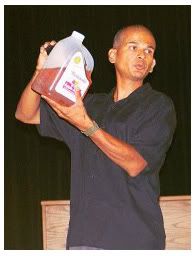
The plea by activist Rodney Coronado [shown here with a jug of gasoline] ends a controversial case that involved free-speech rights and an unsolved arson case in University City in 2003.

Coronado's case went to trial in September, but the jury could not reach a decision and a mistrial was declared. Some on the panel said afterward that the majority was leaning toward acquitting Coronado.

Coronado's lawyer, Jerry Singleton, said that as part of the guilty plea, the government will not pursue two other cases against his client. One in Washington, D.C., involves the same charge stemming from a speech Coronado gave at American University there. (SD Union Tribune)
Coronado is a cause celebre in the radical animal rights movement, and his guilty plea ends his years-long effort to exploit his criminal behavior to draw more goofball animal lovers into his Animal Liberation Front terror cells.

Note to warden: Throw away the key.

Where Is The Passion?

On Capitol Hill, they drone on with their "my esteemed colleague" this and "the gentleman from North Dakota" that. Yawn. Where is the passion?

Is it just that we're not eating enough kimchee?

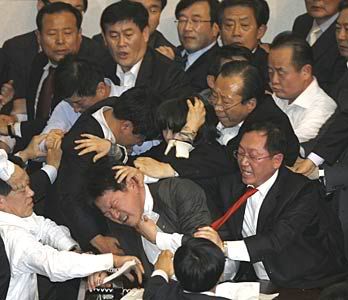
Who even knows what they were fighting over this time at the Korean Parliament? Sky News just calls it "an election fight." Whatever.

It's comforting, isn't it, to know that while Samsung and LG and Hyundai are becoming globally competitive and knocking our products around, the SoKo government is knocking itself out.

Stupid Penguins Warmies

Where is the intelligence in this?
Penguins In Peril As Climate Warms

ScienceDaily (Dec. 15, 2007) — The penguin population of Antarctica is under pressure from global warming, according to a WWF report.

The report, Antarctic Penguins and Climate Change, shows that the four populations of penguins that breed on the Antarctic continent — Adélie, Emperor, Chinstrap and Gentoo — are under escalating pressure. For some, global warming is taking away precious ground on which penguins raise their young. For others, food has become increasingly scarce because of warming in conjunction with overfishing.
There's causality between overfishing and global warming? Did not know that?

I also did not know that the penguins had not survived the multitude of previous warming/cooling cycles they've been through. Pity they were wiped out the last time it got warm!

Oh, they weren't wiped out last time? Perhaps someone should tell the WWF, since the the Greenie/Warmie WWF does not appear to have the collective IQ of that other WWF, the ones that smash themselves up in a wrestling ring.

Labels: , , , , , , , , , , , , , ,

Saturday, September 01, 2007

Smelt Dealt: Greenies Gut Water Supply

The Fresno courtroom was packed to the gills yesterday, with people even sitting in the jury box to hear U.S. District Judge Oliver W. Wanger's decision regarding a three-inch fish's impact on a thirsty state. If it's drama they want, the Delta smelt ruling didn't disappoint.

In a conclusion that was pretty much foregone due to the inflexibility of the Endangered Species Act, Wangler ordered pumping of San Joaquin Delta water cut by as much as 37 percent from December through June.

The two sides -- Greenie fanatics and sober ag and urban water providers -- now are supposed to sit down and agree to a plan to implement the ruling. If they can't work together, Wanger will write the plan himself, placing an unelected judge in solo control of most of California's water supply.

Greenies, as is their wont, after chanting "Doom, doom!" for years, demanding that draconian measures are necessary to save a critter, are downplaying the ruling's negative effect now that their scare-mongering has helped bring them victory. For example, attorney Kate Poole (an ironic name, given the effect of the ruling on water supply) was already dismissing any projections of big negative impacts:
Poole, senior attorney for the Natural Resources Defense Council, questioned the officials' numbers. "I don't think they can say that," she said. "I don't think anybody has yet figured out how much delivery reduction this would cause." (LA Times)
Well, Katie girl, if you shut down the pumps 37 percent of the time during the spring and winter -- in other words, the only time when there's a lot of water to pump -- you are going to have a profound, pooch-screwing impact. You and your Greenie attorney comrades made the bed, Katie, now fess up and sleep in it.

Here's how Tim Quinn of the Association of Cal Water Agencies described the impact of Wangler's ruling:
A sober assessment of this says it's a very large deal. We are not only losing supply here, you are greatly compromising the tools we have developed to deal with water shortages. (Fresno Bee)
What Quinn means is this: During the winter and spring, ag and urban water districts pump their reservoirs full with snowmelt water that is flooding into the Delta -- what used to be called surplus water, but is now called water for endangered species. If we can't fill our reservoirs during the rainy and snowmelt months, our reservoirs will not be able to provide the supplies needed to get us through the dry months.

There's a beneficial result of all this: more conservation. I'm a fan of conservation. But we represent some water districts and I can tell you that conservation is already taking hold big-time without Greenies forcing it down our throat.

Greenies will counter that the fish had to be saved. Bogus argument. If they were truly more about the Delta smelt than they are about water policy, they would have not pursued this through Endangered Species Act litigation, but by a holistic effort that looked at seawater intrusion, the introduction of non-native species, chemical pollution and pump activity.

By focusing on the pumps and using the inflexible Endangered Species Act as their sledge hammer, their agenda is clear: Writing new policy through the courts for California's ag industry and the residents of Southern California. But if you write broad policy based on narrow objectives, as worthy as the objective of protecting the Delta smelt may be, it will necessarily be bad policy.

And as California's drought continues, the timing couldn't be worse.

Labels: , , ,

Wednesday, August 22, 2007

Brown Grass Ahead?

In a Fresno court room yesterday, U.S. District Judge Oliver W. Wanger presided over a lengthy hearing that will ultimately lead him to the unenviable role of having to put a fish over the economic wellbeing and quality of life of humans in California.

The subject was the Delta smelt, a perfect enviro-species. Like the California gnatcatcher, a bird the enviros used successfully to halt development on hundreds of thousands of acres in So Cal, the smelt can be deftly handled to halt water deliveries from the Delta. The pumps that move the water southward make fish paste of the smelt, so the little fish casts a big shadow.

Why would someone want to keep folks from getting water? Because, in enviro-think, if you cut off the spiggot, you cut off growth, and for the anti-capitalist, pro-Gaea forces of Green, growth is a bad, bad thing.

The Greenies pushed hard at yesterday's hearing, with their key witness, fish prof Peter Boyle, in the witness box for six hours testifying about how the fish is at imminent risk of extinction. I've heard the words "imminent risk of extinction" cavalierly applied to so many healthy species that to me the words have no more significance than, say, McDonald's Big Mac.

But he pressed on, pushing for the Green scheme of shutting off the pumps for up to 75 percent of the time, since so few smelt remain.

Farm interests, on the other hand, argued that there are millions of Delta smelt, that a plan is in the works to protect them and no dire steps need to be taken prior to its completion, and the pumps should only be shut down less than five percent of the time.

The state came in recommending that the pumps be shut down around 50% of the time -- a huge reduction in water from the Delta.

What's really going on here

We have the Greens pushing hard for a major victory, and he have the state pushing hard for a train wreck.

The Gov has a massive water bond proposal in the works, and it's not another one of those bonds that fritters good money away on bad programs. This one would resurrect the peripheral canal, bringing No Cal water south by skirting the Delta entirely, protecting the fish and supplying the thirsty South.

The last time it was tried, mega-farmer JG Boswell stopped it in its tracks, spending millions in No Cal to gather votes against it. This time, he realizes he was mistaken and is supportive of the measure.

Schwarzenegger wants the train to crash over the smelt. He wants brown lawns, layoffs, mandatory water rationing and economic ickiness, so he can build a healthy margin for his canal bonds and avoid the defeat suffered by the earlier effort.

Trouble is, even if the bonds pass, it'll take a decade at least to build the canal -- and if we're looking at a trickling faucet the entire time, then the Greenies will gleefully watch as the So Cal economy, the largest in the nation, suffers through a long, long drought.

Labels: , , ,