Cheat-Seeking Missles

Sunday, May 25, 2008

A Euro-Editorial Against Obama!

Here's how most Europeans think about American elections, according to the Financial Times Deutschland:
American politics have undergone drastic change in the past decades except for one thing: we Europeans and especially we Germans hope for a Democrat at every election. We dream of a Kennedy and are then disappointed when we get a Nixon, a Reagan, or a Bush. We thought Reagan was an actor and George W. Bush was a lunatic. And we celebrate each time the Americans bring out a Clinton, a Gore, or an Obama. We celebrate because these candidate’s politics come closest to resembling our nebulous European sentiments.
So of course they're all giddy over Obama ... all except for this same Financial Times Deutschland:
As a European, I can’t really imagine why we would want a President Obama. His “Invest in America” policy can hardly be topped as protectionist mindset, and his “Fair Trade” policies would lead to a restriction of world trade. All this under the cloak of social justice for his constituents.
If it's all about the economy, stupid, we need a president who can bring us out of the current economic transitional period -- and that won't be the guy who ignores the free market and attempts to force the world economy into a protectionist, non-cooperative box.

On foreign policy, Obama will talk to anyone. On the economy, he'll talk to no one; his mantra is to talk to no one, no Fair Trade, no foreigners allowed. All that means is that the world will move along without us.

It's just the stuff to expect should you be foolish enough to elect a neophyte as president.

Hat-tip: Watching America

Labels: , ,

Thursday, May 22, 2008

The Oil Bubble

Breathless. That's the word that comes to mind on reading today's NYT coverage of the big oil story. A couple other words come to mind. Frightened and sensationalistic. Stupid is another. Here's the lead:
Worries that world oil demand will outstrip global supplies intensified on Thursday, sending ripples through the global economy as oil prices leaped above $135, a new record high.

The price spike occurred overnight, and by Thursday morning oil had fallen back slightly to $132.87, down 30 cents from its close on Wednesday.

But the leap capped a rally that has seen oil rise nearly $5 a barrel in two days, underscoring the dire implications of the current price run-up for businesses across the globe.
Let your memory range back ... way back ... to 2006 and all the stories about home prices. What one word comes to mind as you recall those stories? Was it "bubble?" It sure was for me, but I have not yet read anything about an "oil bubble."

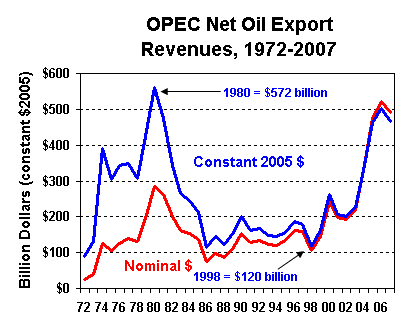
And why not, considering this:
If I had found a chart that was a bit more current, you would have seen the current spike reversing its early 2007 downturn and heading skyward again, but that's not what's relevant. What's relevant is the very evident peaks and valleys in OPEC oil revenues since the early 197os. It tells us that when oil reaches unsustainable prices ... well, then those prices aren't sustained.

I've made the point in the past that much of the spike in oil prices is due to new demand from developing nations, and if that were wholly responsible for the price of oil today, we couldn't expect a drop. But it's not wholly responsible; speculation, lagging production and refinery undercapacity are all factors as well.

Seventeen paragraphs into the NYT story, we find this:
But [Michael Masters, a portfolio manager at Masters Capital Management] cited data showing that the increase in demand from index speculators over the past five years is almost equal to the increase in demand from China.
Speculators were also very evident in the run-up of the housing market, when it was not uncommon for the percentage of speculator buyers in new home developments to be in the double digits -- and they were mostly buying resale homes, not new ones. When they sensed the market had reached its peak, they left like rats leave a sinking ship, and they'll do it with oil, too; probably pretty soon.

Oil refinery capacity won't do anything to help the current situation because it takes too long to bring new refineries on line, but what of production? Certainly, the Middle East could increase its production by hundreds of thousands of barrels a day if it wanted to -- but why would it want to? Hard crash, soft crash, what difference does it make to them with the cash reserves they've got?

As stewards of a finite resource, the OPEC nations are always more motivated to under-produce than over-produce. Not only does it ensure a good price; it also ensures that they'll have oil to sell for longer. But OPEC isn't the only story in oil, by a long shot.

Hillbilly White Trash nails the production aspect of the story:
The United States has untapped reserves of oil in Alaska, off the West Coast, the East Coast and the Gulf Coast and we are unwilling to drill for them. We also have around 1.5 - 2.6 trillion barrels of oil in oil shale deposits. This gives the United States at least three times the oil reserves of Saudi Arabia.

In addition to this there is a process for liquefying coal and turning it into a motor fuel which is interchangeable with petroleum. The Germans developed the process during the Second World
War and South Africa continued development on the process, using it to supplement their own supplies of petroleum. We have more coal than the Saudis have oil.

If the United States had spent the money which it has wasted on impractical technologies like wind and solar power (not to mention the money we've poured down the ethanol rat-hole) on perfecting the liquefaction of coal and the extraction of oil from shale we would not only be energy independent but the world's largest exporter of of oil and oil substitutes.
As long as we're not willing to exploit our resources, he asks, why should the Saudis and their friends exploit theirs to protect us? You'll look hard for a good reason.

The current run-up in oil prices should have unlocked some of our energy resources, but with the Dems in control of Congress, it will not happen. So the bubble will burst again before we begin to once again take production seriously, and we will continue to be beholden to the world market for the oil which drives our entire economy.

Oil prices will fall, and will rise again. Maybe by the next upturn, we'll finally be willing to get serious about taking care of ourselves by utilizing the wealth of resources God gave us.

Labels: , ,

Saturday, May 03, 2008

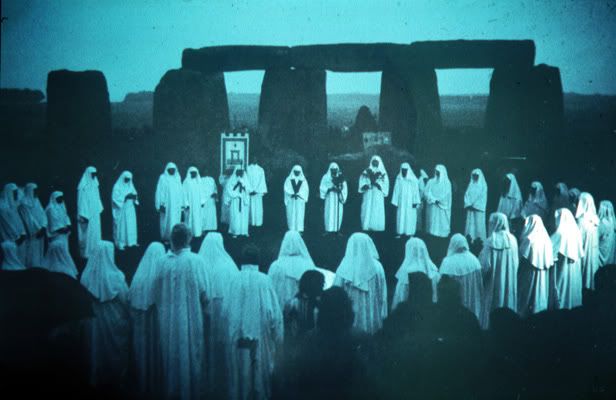
Gaia Vs. Druidity

Gaia vs. Druidity? Hmmm. That was the subject line on an email my friend Neil sent me rather late Friday night. It started with an interesting interpretation of things and ended with a whacked-out bit of history that could come back all too soon if the Dems win in November, so here goes:

We'll start with some basic economics with a liberal lens:
"At the same time, soaring costs of energy and food are among the ways that a market-based society attempts to maintain equilibrium when supply fails to keep up with potential demand. Rationing by price is a profoundly inequitable way to sort out who gets food and energy in a time of shortages, and who does not, but unless the industrial world goes through drastic political changes in the very near future, it’s the way we’re stuck with, and it does have at least one pragmatic advantage: the ration coupons (we call them “money”) and the entire system of rationing are already in place, ready to use, without massive social engineering."
'Tis true and it can be a cruel system, but the last couple hundred years of human history has proved beyond the shadow of a Krugerrand that there is no better system. When times get tough for folks and they need more "ration coupons," the system provides two solutions: working harder (preferred) or stealing from others welfare (preferred by "progressives").

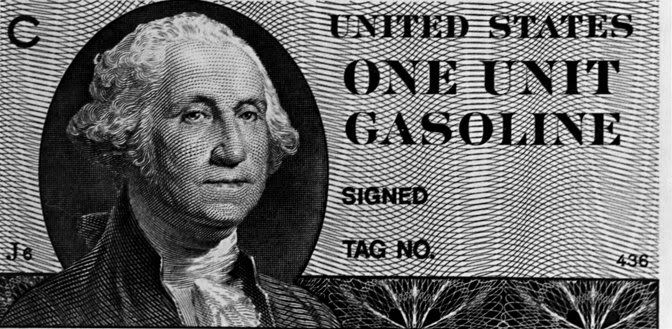
As it turns out, though, we apparently came pretty close to another kind of coupon in 1974 and 1975, when the wayward government ordered up millions of gas rationing coupons in anticipation of a crazy free-market run on the pumps.

Neil, who worked for the feds for a number of years and developed a healthy sense of humor about them as a result, wraps up the story:
The story gets worse. During Gasoline Crisis I, which brought out the worst in people when I was working at Seat of Government, billions of these coupons were indeed printed. To guard against, and verify, counterfeiting, the Powers that Be, in their Infinite Wisdom, decided to engrave the same George that is on the dollar bill. Anyone could compare the faces and detect a phony.

The story really gets worse. Some enterprising bureaucrat discovered that you could tape the coupon to a piece of paper the size of a dollar bill, run it through a change machine, and get four quarters. The government would be giving away money.

So the Powers that Be exercised more of their Infinite Wisdom and destroyed all the coupons, not realizing that gasoline would soon climb above $1 per gallon and only drooling idiots would trade their coupons for less than face value.
These are the fine people we entrust our freedom, sovereignty, health [NOT YET!], security and economic well being to.

Gaia vs. Druidity? Your guess is as good as mine.

Labels: , ,

Thursday, April 24, 2008

Oil Prices May Fall, Just In Time For McCain

I just filled my beautiful German V8 (18.9 mpg) with $4.11 a gallon gasoline. That was an unwelcome first! Did it make me want to vote for Obama or Hillary?

Of course not -- with their sucking up to the enviros and love of regulation and Big Gov, they haven't a clue what to do about oil prices.

Fortunately the free market knows exactly what to do -- and it looks likely a correct will come in time to keep McCain from being saddled with a deepening recession:
The roaring oil boom of the last few months may be on its last legs as economic growth slows hard across the world and a clutch new refineries come into operation, Lehman Brothers has warned in a hard-hitting report.

“Supply is outpacing demand growth,” said Michael Waldron, the US bank’s oil strategist.

“Inventories have been building since the beginning of the year. We have pretty significant projects starting soon in Saudi Arabia, and large off-shore fields in Nigeria,” he said.

The Saudi Khursaniya field has just opened with 500,000 barrels a day (b/d) of production, and the new Khurais field will start next year with a further 1.2m b/d.
The [UK] Telegraph report goes on to blame the recent price run-up on the same folks that brought us the pre-crash real estate price run-up, speculators.
Lehman Brothers said the price of oil had been pushed to inflated levels by a $40bn inflow into commodity index funds this year, much of it coming from Mid-East sovereign wealth funds.

The petro-investors may have second thoughts about gaining “double exposure” to commodity prices.

“Financial flows have been the marginal driver of prices since the onset of the credit crunch. Investors are using oil as a hedge against inflation and a falling dollar,” said Mr Widmer.
Once again, recent media reports on oil prices have sounded like prices will continue to go up and up and up with little hope for relief. This is to be expected since most MSM reporters have bought into the false Greenie belief that all resources have been exploited to the breaking point.

If the Lehman projection is correct (they didn't call the housing crash right, so don't file their prediction in your "guaranteed" file), it will lead to lower prices quickly enough, which in turn will lead to happier consumers, which will be good news for the GOP, come November.

Labels: , , ,

Wednesday, April 09, 2008

Obama The Wimp

Apparently no one has briefed Barack Obama that he is running for president of a country called the United States, which, last time I checked, was the most powerful and influential nation on the power.

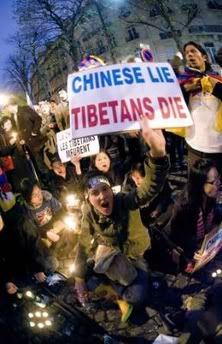
Here is the Dem front-runner's response when asked his position on China, Tibet and the Olympics:
"It's very hard to tell your banker that he's wrong," Obama said, after talking about the need to restore America's stance in the world, "And if we are running huge deficits and big national debts and we're borrowing money constantly from China, that gives us less leverage. It give us less leverage to talk about human rights, it also is giving us less leverage to talk about the uneven trading relationship that we have with China." (ABC)
Just because Beijing's sitting on a fat wad of our treasuries, we don't have any leverage at all with them? The fact that they depend on our markets means nothing? Or perhaps the fact that we can exert all sorts of trade and diplomatic pressure because of this little thing called influence?

Unbelievable.

This is Obama on the relatively soft issue of human rights. Imagine Obama going to Tehran to talk to Ahmadinejad if this is all he thinks of the power and influence America. Imagine what he thinks of our capability to achieve victory in Iraq.

And ask yourself, what do you think he'll be able to do to help our economic situation if he's this defeatist about one of America's economic problems?

hat-tip: memeorandum

Labels: , , ,

Monday, March 24, 2008

Economics 101 For MSM, Hillary?

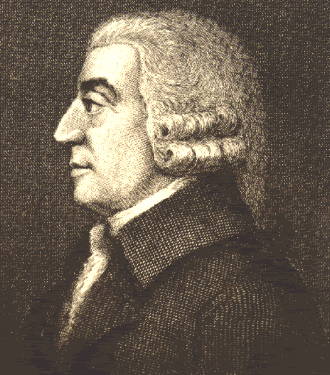
Adam Smith, cover your eyes. I'm about to reveal something that would be very upsetting to Mr. Invisible Hand, were he still with us.

AP, the world's largest news distribution service, and therefore, one would think, one of its best, led off a story on the housing market today with this gem:
After falling for six straight months, sales of existing homes posted an unexpected increase in February. But the median home price tumbled by the largest amount on record.
"But?!" Obviously, "because" is the right word. Anyone with even a modest understanding of economics knows that government programs and bailouts aren't going to be what starts bringing the housing market back. But lowering prices (and making more mortgage money available) will. In February we saw that: Prices dropped and people bought.

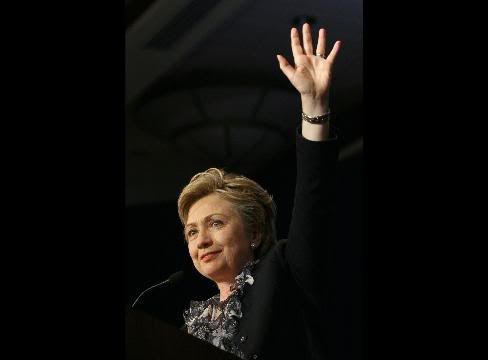
Meanwhile, Ms. Change (seen here signaling for eight more Clinton years), showed off that she's right there in the dunce's corner with AP, as she called for an "emergency working group on foreclosures" led by -- here's a new face -- Robert Rubin, her hubby's econ czar who helped the Clinton administration skate by on Reagan's robust economy almost until the end of Bill's second term, when it all collapsed.
Such a panel would recommend legislation and other steps to "help re-establish confidence in our economy," Clinton said in prepared remarks for a speech on the economy in Philadelphia. She and Sen. Barack Obama are campaigning heavily in Pennsylvania, which holds its presidential primary April 22.

Clinton also proposed greater protections for lenders from possible lawsuits by investors, a version of so-called tort reform more often associated with Republicans than Democrats.
Uh-huh. Washington DC can re-establish confidence in the economy; we all believe that ... just let us find our WIN buttons. And we're all sooo behind Hillary on her bright idea to stiff investors -- what do they do besides fuel the economy, anyway? -- in order to bail out financially dumb or greedy people who are stuck in bottom-of-the-barrel mortgages.

The failed mortgages are made up, in large part, of claimed income mortgages, and most of the failed claimed income mortgages are ones in which the relationship between the claimed income and the real income is tenuous at best.

In other words, they lied and Hillary cried.

Being used to covering for liars, Hillary wants to take care of these people so they can live to lie again. Why teach them a lesson when you can bail them out again and again, ensuring that they'll continue to vote Democratic?

Here's a better solution, and it's already done without the help of the junior senator from New York and her know-it-all buddies:
Government regulators are reducing capital requirements on Fannie Mae and Freddie Mac in a bid to add liquidity to the troubled mortgage market.

The Office of announced Wednesday that it has cut the government-sponsored mortgage investors' surplus capital requirement to 20 percent from 30 percent.

The office estimates that this reduction, in combination with the release of portfolio caps announced last month, should provide up to $200 billion of immediate liquidity to the mortgage-backed securities market, and allow Fannie Mae and Freddie Mac to purchase or guarantee about $2 trillion in mortgages this year. (source)
Unlike Democratic senators running for president, the housing market economists at the Federal Housing Enterprise Oversight understand that making more money available for mortgages will make mortgages cheaper and more plentiful. They also understand that this is a temporary fix, and capital reserve levels should return to 30% once things straighten out.

I am a part of the housing industry. I have seen many friends laid off and am watching as a couple friends hold on by their fingernails to their companies. It is not a good time for us -- but we all know that the last decade, which was incredible for the industry, would not have been possible if the already heavy hand of government were any heavier in our industry. So we also know that letting Hillary and her big government ilk have her way is not going to help in our recovery.

We were drunk in the good market and we're hung-over today. And no thanks, Hillary -- keep your snake oil hangover solution to yourself.

Labels: , , , , ,

Friday, December 28, 2007

My Dinner With Grover (And Ron Paul's VP?)

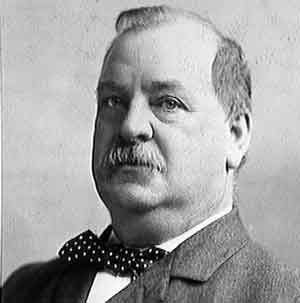
After Ronald Reagan, Grover Cleveland just might have been the last great American president.

That sentiment would have gotten me cross-wise with my hosts last night, who would not have put in the Ronald Reagan qualifier. No, friends, the folks at the Grover Cleveland Social Club hold the 22nd president (and 24th, as Cleveland was the only president to come back after a hiatus and be re-elected) in exceptionally high esteem.

Grover was admirable, indeed, a man of character the likes of which I don't see among any of the current candidates ... although last night's hosts would argue that Ron Paul is Grover Cleveland reincarnated.

Here's a quote that packages Cleveland pretty niftily. In it, he is addressing his thoughts on federal aid to farmers whose crops had been damaged by drought:
"Federal aid in such cases encourages the expectation of paternal care on the part of the Government and weakens the sturdiness of our national character...."
Prescient, huh? Especially from a Dem! The White House's history archives, provide the following brief summary of Cleveland's primary policy efforts:
He also vetoed many private pension bills to Civil War veterans whose claims were fraudulent. When Congress, pressured by the Grand Army of the Republic, passed a bill granting pensions for disabilities not caused by military service, Cleveland vetoed it, too.

He angered the railroads by ordering an investigation of western lands they held by Government grant. He forced them to return 81,000,000 acres. He also signed the Interstate Commerce Act, the first law attempting Federal regulation of the railroads.

In December 1887 he called on Congress to reduce high protective tariffs. Told that he had given Republicans an effective issue for the campaign of 1888, he retorted, "What is the use of being elected or re-elected unless you stand for something?" But Cleveland was defeated in 1888; although he won a larger popular majority than the Republican candidate Benjamin Harrison, he received fewer electoral votes.

Elected again in 1892, Cleveland faced an acute depression. He dealt directly with the Treasury crisis rather than with business failures, farm mortgage foreclosures, and unemployment. He obtained repeal of the mildly inflationary Sherman Silver Purchase Act and, with the aid of Wall Street, maintained the Treasury's gold reserve.

When railroad strikers in Chicago violated an injunction, Cleveland sent Federal troops to enforce it. "If it takes the entire army and navy of the United States to deliver a post card in Chicago," he thundered, "that card will be delivered."
After the last several presidents' failure to control either the size of government or its spendthrift ways, all this sounds positively delightful.

Because the hosts of the evening -- OC Reg commentary writer Steve Greenhut, his former colleague John Seiler and friend Tony Bushala -- are all Libertarians, big and little "L" Libertarians abounded at the event, including Art Olivier, former Libertarian candidate for California governor and U.S. Veep.

Art and I chatted for some time, and he explained why Libertarians run in the face of insurmountable odds. I thought it was to educate and educate and educate people until we get the concepts through our dense heads, a point he agreed with in more polite terms, but he said he runs to keep the party alive.

Eventually, he feels, the stars will align with the right candidate at the right time, and the Libertarians will advance beyond their current place, where they are unable to get any higher than city councils, and break onto the national scene. Until then, his job is to keep the flame burning.

All things are possible, folks. The status quo is not forever. But Libertarian naivety on foreign policy will keep 2008 from being that year.

Olivier also revealed:
  • If Ron Paul doesn't get the GOP nomination (and they view that as a big "if"), he will run for president as the Libertarian candidate.

  • He believes such a candidacy will hurt both the GOP or the Dems. He feels if the Dems nominate Hillary, anti-war Dems will vote for Paul, as will GOP voters concerned more about privacy and big government than the War on Terror.

  • He, Olivier, would run for Vice President.
He would be an asset to any ticket -- tall, handsome, well-spoken, personable and approachable. I only wish I would have asked him how he feels about the 9/11 Truthers' Moonbats' attraction to Paul. Who in the world would want to get into office on the shoulders of that sad bunch?

Labels: , , , ,

Wednesday, December 12, 2007

Paulson-Bush League

John Burns is a real estate guru who's usually right on the money. He certainly is with this:
We can't find anyone credible who believes the Paulson-Bush plan that was announced on December 6 will significantly help the housing market.
Still, that doesn't mean Congress can't make it worse.

The few hundred thousand people that would be eligible for protection under Paulson-Bush are not enough to impact the market, particularly if you consider that some of these folks got into their houses with zero money down.

Now if you had nothing in your house and your payment was about to go up a few thousand bucks a month due to nothing other than your stupidity in selecting your loan, which option would you choose?
  1. Fill out all kinds of papers and hold onto the house as it continues to fall in price from whatever price you paid for it, so it might be ten years or so before it gets back up to break even.

  2. Walk away from it, lose nothing, rent for a while, and buy a home that's just as nice for less once you've got your credit straightened out.
See why Paulson-Bush is more about doing something than doing something intelligent?

Labels: , ,

A Welcome Global Move To Ease Credit

News of a global effort to ease the credit crunch is welcome, indeed, and far superior to the President's dangerous, unfair and inequitable proposed solution to the mortgage meltdown.

Over the last couple days, I have spent hours with the leaders of Southern California's home building industry. (Although I can hardly drive a nail, I guess I'm a leader of the industry as well, as I serve as public affairs VP for the industry's So Cal trade association, the largest and most watched in the nation.)

To a person, they are pessimistic for the short term and ebullient for the long term -- from perhaps 2010 on. All of them predicted a downturn and were preparing for it, but none anticipated the precipitous drop created not by a lack of demand but by a lack of credit.

How precipitous? Last year, new home sales and remodels in So Cal had a value of $17.9 billion; this year, it will be $5.5 billion less, according to the Construction Industry Research Bureau.

Adversaries in the no growth movement (the Greenies, Warmies and NIMBYs) may be desirous of a crumbling economy, or they may be ignorant, but if they are celebrating housing's stumble, they should know the price: The So Cal economy took a $12 billion hit in 2007 because of the drop.

Since the market adjustment started in 2004, SoCal's economy has lost $38 billion in economic activity that were lost as the value of new homes, remodels and new business activity created by them shrunk, according to CIRB.

This is the largest new home market in the country, but numbers of such a scale are cropping up in nearly every market across the country. As goes housing, so goes America's economy.

That's why this news from WSJ is so encouraging:
The Federal Reserve has joined with four other major central banks to announce a series of measures designed to inject added cash into global money markets in hopes of thawing a credit freeze that threatens their economies.

The Fed said today it would create a new "term auction facility" under which it would lend at least $40 billion and potentially far more, in four separate auctions starting this week. The loans would be at rates far below the rate charged on direct loans from the Fed to banks from its so-called "discount window." But the new loans can still be secured by the same, broad variety of collateral available that banks pledge for discount window loans.

The European Central Bank, Bank of England, Bank of Canada and Swiss National Bank simultaneously announced parallel measures.

Stock futures soared Wednesday on the news, a day after the Fed's rate moves disappointed the market.

The Fed also said it had created reciprocal "swap" lines with the European Central Bank, for $20 billion, and the Swiss National Bank, for $4 billion. These will enable the ECB and SNB to make dollar loans to banks in their jurisdiction, in hopes of putting downward pressure on interbank dollar rates in the offshore markets, principally the London Interbank Offered Rate, or Libor, market. The inability of foreign central banks to inject funds in anything other than their own currency has been a factor creating the squeeze on bank funding in those markets.
Because home sales today are not so much for homes, but for deals, stabilization is the first step toward recovery. As long as buyers remain reticent to close a deal because they think tomorrow will bring a better deal, sales will continue to drop.

The Fed's move, by freeing much-needed new sources of credit, can bring new buyers into the market, and builders were working to diminish their standing inventory over the last couple of years, it won't take too many sales before supply and demand achieve equilibrium.

With all the expected disclaimer, investors might want to start looking for deals in homebuilder stocks. There are risks of bankruptcies in the short term, of course, but the companies that make it through should begin appreciating quite robustly in a few years, thanks to moves like the Fed's today.

Labels: , ,

Tuesday, November 13, 2007

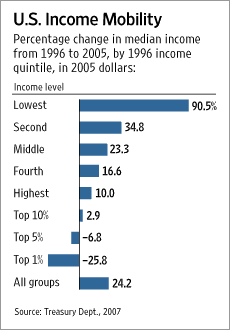
Show me a country anywhere that can match this chart, with the possible aberration of China, and I'll be stunned.

Prepared by the U.S. Treasury Dept. from a scan of nearly 100,000 tax returns (vs. polls of 1,100 that purport to tell the electorate's whims), the study shows that America continues to be a nation where people move up.

Over 90% of the people in the lowest income bracket over up in income between 1996 and 2005, as did over a third in the second lowest, and nearly a quarter in the middle income bracket.

And those super rich, who just keep getting richer at the expense of everyone else. A quarter of them saw their income nose-diving, which is the other part of America's great free market capitalist machine. John Edwards, you'd better tax the daylights out of them now before their income (like yours, presumably) starts to tumble.

In presenting this data in an editorial today, the WSJ concluded:

All of this certainly helps to illuminate the current election-year debate about income "inequality" in the U.S. The political left and its media echoes are promoting the inequality story as a way to justify a huge tax increase. But inequality is only a problem if it reflects stagnant opportunity and a society stratified by more or less permanent income differences. That kind of society can breed class resentments and unrest. America isn't remotely such a society, thanks in large part to the incentives that exist for risk-taking and wealth creation.

The great irony is that, in the name of reducing inequality, some of our politicians want to raise taxes and other government obstacles to the kind of risk-taking and hard work that allow Americans to climb the income ladder so rapidly. As the Treasury data show, we shouldn't worry about inequality. We should worry about the people who use inequality as a political club to promote policies that reduce opportunity.

Opportunity is knocking, so there's no need in America to open the door to populism or more big government handout programs.

Labels: , , ,

Sunday, November 04, 2007

Sunday Scan

It's NOT the Economy, Stupid
Tune in a Dem prez debate and prepare to get the glummies about the economy. Where would the Democrankies be without their charges of the rich getting richer, the jobs going overseas and the economy of the verge of tanking?

Bulletin to Hil et. al.: Do not read Thomas C. Reeves' The Terrible State of our Economy? that's up on History News Network. In the piece, Reeves makes enough points to make Hil look like a giant stack at Waffle House, including:
  • "In the first place, it now seems certain that the Bush tax cuts of 2003 stimulated the economy. Individual income tax receipts, according to the Congressional Budget Office, have soared by 46.3% in four years. In 2007, the IRS collected a total of $2.568 trillion, 6.7% more than the year before."

  • "The wealthy paid much of the bill; in 2005, the richest 1% paid 39% of all income taxes, up from 37% in 2000. (At the same time, the bottom 50% of families enjoyed an average tax rate that fell by a third to 3%.)"

  • "For fiscal 2007, the CBO predicts a federal budget deficit of $158 billion, a $96 billion decline from 2006."

  • "Federal spending (despite Iraq and the continued impact of Katrina) is growing at a lower rate, up just 2.8% last year, comfortably below the 7.3% average over the previous five years."

  • "The U.S. Treasury Department reports that in September, 110,000 new jobs were created, “the 49th straight month of job gains.” The nation has added 8.4 million jobs since August, 2003."
And on and on Reeves goes, rebuttal after rebuttal of the major Dem talking points on the economy. Wag a finger at Bush's management of the economy, Dems, and chances are Reeves will bite it off.

Who Started al-Qaeda Anyway?
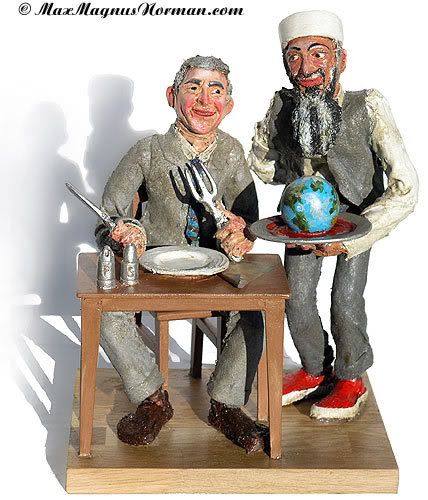
You may have thought our blood enemy got its hatching in the mind of bin Laden, as he toiled away as a rich young mujahadeen against the Soviets in Afghanistan ... but you'd be wrong, half a world away wrong.

Here, from that pillar of truth, Iran's Fars News Agency, is what really happened:
"The Untied States has deployed its military troops in 8 different countries in the region in a bid to control oil reserves and secure free flow of oil," representative of Tehran at the Islamic Consultative Assembly Hossein Sheikhol Eslam said while addressing a meeting dubbed "A World without US Intervention" in the northern city of Behshahr Saturday night. ...

"But after it failed in attaining [Saddam's victory over Iran], the White House leaders thought of new plots to maintain their domination over regional reserves, including the formation of such terrorist groups as the al-Qaeda," he said.
See, we created al-Qaeda all because of our lust for oil and power. It's nice to know there's someone more paranoid and anti-American than the American left.

Image credit here.

Maria Shriver for President?

I don't think so, and neither does Arnie. He told a group of Silicon Valey business leaders Friday that Shriver has no interest in the job because of her upbringing:
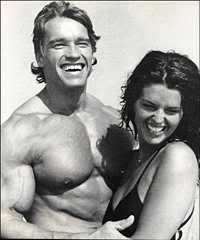
"She grew up and was a victim, where she was always thrown into events and photographs, and Sunday nights there were always 100 people in the house ... and she was at the factories telling people, 'Vote for my daddy, vote for my daddy,"' Schwarzenegger said.

"When she was 21 years old, she went out and decided she would find a man who had no desire to be in politics. She bumped into a man who was from an Austrian farm, a bodybuilder who was only interested in oiling up ... and wearing tight pants ... and then going into Hollywood," he said to more laughs. (OC Register via Flash Report)

First Take Out The Media

Pervez Musharraf is following classic coup procedures. On day one, he took out television and his main enemy, Pakistan's supreme court.

On day two:
Hundreds of political activists, senior judges and human-rights leaders were rounded up by police. The country's deposed chief justice, Iftikhar Chaudhry, was confined to his cordoned-off home, with no one allowed to approach. ...

Some of the country's most venerable jurists and human-rights activists were among those rounded up and roughly bundled into police vans.

They included Munir Malik, a senior attorney who has been at the forefront of a pro-democracy movement that swelled in recent months, and Asma Jehangir, a distinguished lawyer who leads the independent Human Rights Commission of Pakistan.

Up to 200 policemen stormed the office of the rights commission in the eastern city of Lahore, arresting all the group's senior staff. (LA Times)
It occurred to me this morning that The Lives of Others, which I reviewed yesterday, would be reviewed quite differently by the Kos Krowd. They would see East Germany's repression not as a window into places like Pakistan and NoKo, and a cry for the need for democracy, but as a warning of what Bush would like to do to our country.

I'm sure that as they read of Musharraf's closing down of Pakistan's tenuous Democracy, they're thinking in their negative little minds that Bush will be following his puppet shortly. What a waste of creative brainpower.

"Gen. Musharref, Saakashvili's on the Phone"

One person looking enviously at Musharref is President Michael Saakashvili of Georgia. How he must long for tough martial law and the jailing of dissidents.
Up to 10,000 Georgians demonstrated for a third day against Presidential Mikhail Saakashvili on Sunday, accusing him of authoritarian rule and demanding his resignation.

Some 70,000 had rallied in front of Georgia's parliament building on Friday, calling for a parliamentary election to be brought forward to early 2008 as a step to abolishing the presidency. By Saturday, opposition activists were mounting pressure for Saakashvili to step down. (Reuters)

Saakashvili came to power backed but just such demonstrations, dethroning Eduard Shevardnadze in 2003's Rose Revolution. But revolutions can be demanding things, and Georgians are fed up with the economy and allegations of human rights abuses.

Georgia should be, as our president has called it, "a beacon of democracy," and it can be again if Saakashvili simply calls early Parliamentary elections.

Judge Mukasey is not Alberto R. Gonzales

So writes Diane Feinstein in today's LAT, in saying that Mukasey's got her vote. She goes in the face of Leahy, Schumer et. al. and says Mukasey has answered the questions, especially the questions on waterboarding, sufficiently and should be confirmed.

Go Di. I disagree with her often, but have to admit she shows an independence from the Dem goose-steppers frequently enough to still earn my grudging respect.

Shakin' Things Up
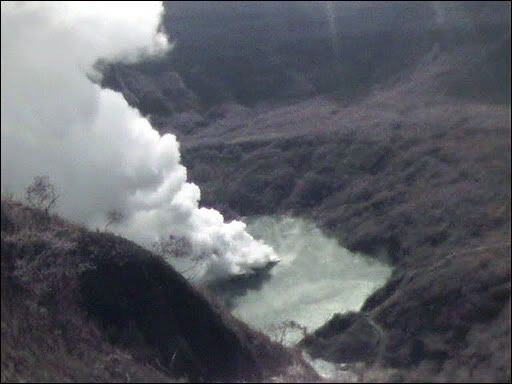
How bad is it when the ground shaking is so strong the seismological instruments can't even measure it? I don't want to know; and I don't want to be anywhere close to Mt. Kelut in Indonesia.
A day after a false alarm on Indonesia's Mount Kelut led to panic among residents on its slopes, the volcano is showing signs of an imminent eruption, a scientist said Sunday.

"An eruption is now very, very much possible, although so far it has not yet happened," said Agus Budianto, a geologist monitoring the activities of the volcano in the densely populated East Java province.

On Saturday, continuous tremors beneath the volcano became so strong that they could no longer be read on seismological instruments, leading scientists to evacuate their posts and warn an eruption appeared to have occurred.

They could not confirm it visually as the top of the historically deadly mountain was shrouded by clouds but their warning led residents still in the danger zone to flee in fear for their lives.

Maybe It's The Unintelligible Docs

A recent survey has found that more Americans are discontent with the state of our medical care system than are residents of Australia, Canada, Germany, the Netherlands, New Zealand or the United Kingdom, with theirs. According to the survey, one-third of Americans say the whole system needs an overhaul.
In addition to cost concerns, U.S. patients report more fragmented and inefficient care, including medical record and test delays, perceptions of waste and more time spent on paperwork, compared to patients in other countries.
The study was conducted by The Commonwealth Fund, a group that advocates fundamental shifts in health policy, including a shift from pay-for-services to a system that would pay for each health episode, thereby incentivizing the medical profession to seek more efficient cures.

One third is not 50%, and dissatisfaction with status quo is not a demand for a national health insurance program a la Hillarycare.

Some parts of the survey's conclusions seem questionable, like the finding that Americans say they receive more erroneous test results than patients in the other countries. How do they know the tests are wrong? Do the patients in other countries even have access to their results? The survey reports that the highest number of US patients claiming bad test results are those seeking multiple opinions -- a luxury that may not be afford the citizens under national health care systems.

All in all, the survey shows that the Canadian system is the worst of the bunch and the European systems offer access levels similar to ours. No wonder the GOP always rushes to compare Hillarycare to Canada, and Dems always gaze fondly at Europe.

Labels: , , , , , , , , , , ,

Tuesday, September 04, 2007

How Many More Recalls?

It's happened again:
Mattel Inc. is on the verge of announcing another major toy recall, its third this summer, say people familiar with the matter.

The recall, to be announced tomorrow jointly by the company and the Consumer Product Safety Commission, involves about 775,000 toys, all of which are believed to contain unsafe levels of lead paint, these people said. Two of the toys are designed for preschool-aged children -- one a musical instrument and the other a train toy marketed under the name "GeoTrax." About 100,000 will be affected.

But the lion's share of the recall will affect Mattel's core brand, Barbie. Seven accessories associated with the dolls are set to be recalled, a total of 675,000.
Are contracts being canceled? Are orders being placed with dependable American companies? Or is American business continuing to try China again and again, expecting different results?

If I remember my recovery messages right, that's a symptom of insanity.

Labels: ,

Wednesday, August 29, 2007

A Tutorial On The Ills Of Regulation

I heard a new phrase today: The informal economy.

It's a lovely turn of phrase, sounding much more pleasant and legal than "'the black market economy," but it means the same thing

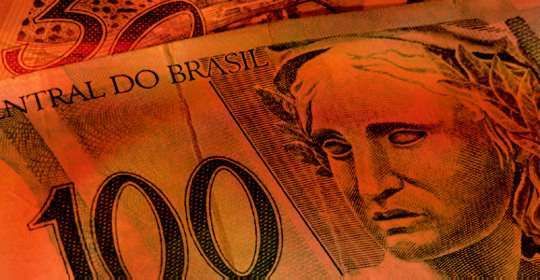
It was used on a BBC broadcast -- not surprising, given their use of gentle, forgiving terms for everything but American foreign policy. I don't believe it's their term, though; it's from Brazil, where the informal economy makes up about half of the national economy. And yes, the other half is called the formal economy.

Those in the informal economy don't get business licenses, get paid in cash for their services and don't pay taxes.

How could Brazil, the dead sleeping giant, come to lose so much of its legitimate economy? It's a one word answer, and it's a word America should hear with fear: Regulation.

Business is heavily regulated in Brazil, from the permits you need to start a business, to the paperwork you have to file to stay in business, to the fines you have to pay if you get crosswise with the regulations. The social bureaucrats in Brazilia have placed such a high penalty on business success, many opt simply not to be successful.

A successful informal economy entrepreneur knows that if he is successful and grows his business, he'll be mired down in a regulatory quagmire, so many opt to just stay small. Imagine the impact on America's economy if Bill Gates had decided it wasn't worth all the hassle to get big, and had continued providing BASIC programming for Altair 8800 computers. Or if Henry Ford had kept turning out Fords one at a time instead of developing the assembly line.

What happens when half of a nation's economy is under the table? Obviously, the Brazilian government receives much less tax revenue because half of its economy is all cash/no taxes. And just as obviously, a country that created this mess because of its propensity to regulate will address the subsequent economic problems with more regulations, more fines for violators ... driving more people to stay away from the whole mess by working for cash on a small scale.

Brazil's problem is repeated in economies around the globe when government thinks it has all the answers.

As yet, the problem hasn't hit America, where most of our economy remains formal, legit, tax-paying and regulated to some extent. But if the trend towards more government, and more government intervention into our lives continues, it could happen here.

If you suddenly start reading about the growing "problems" presented by the informal economy in the U.S., you'll know it's probably already too late; the tipping point has been passed and we're on our way to becoming a sleeping giant.

Labels: ,

Wednesday, May 30, 2007

Vegas' Green Bust

No, Vegas' green bust isn't the latest titillating show on the strip; it's the latest lesson in why we should let the market establish prices and buying decisions. Will politicians ever learn?

In one of today's most-emailed WSJ stories, the tale is told of high-minded Nevada legislators who thought that the construction of green buildings -- buildings that conserve energy and energy, and use earth-friendly building materials -- should be incentivized.

Now, one would think that in a desert city where the temperature routinely reaches 300 degrees or so, developers would need no incentive beyond lower electric and water bills to build green buildings. But legislators didn't get this, so here's what they cooked up:

In 2005 the Nevada Legislature unanimously approved a measure that cut property taxes up to 50% for 10 years and lowered sales taxes for building supplies to 2% for energy-efficient construction. ... Original estimates put state abatement costs at just $250,000, though no one can say how that figure was conjured.

The $250,000 cost was just a wee bit off -- the ding to the state in lost tax revenues is approaching $1 billion. Green buildings already in the pipeline got meaningless incentives and new buildings got decked out in the greenest shades of green, when a lighter shade of green might have been sufficient.

Nevada has no income tax, so when its sales and property taxes flatten, there's no back-up plan for funding schools, road and infrastructure projects except the General Fund. So, and I can't say this any better than WSJ did:

... late last week the Nevada Legislature, already facing budget shortfalls, worked out a retroactive compromise and essentially asked for a mulligan.

The details of the roll-back aren't important; the lesson of the roll-back is. If there's a good product that offers benefits to the market, the market will buy it. The market is smarter than the legislators, every time.

But if the legislators followed this wisdom, how would they keep themselves busy?

Labels: , ,

Wednesday, May 23, 2007

The Poor Just Get ... Richer

W's in office and for six years, the selfish GOP had Washington in its greedy grip, cutting deals with Big Oil, Big Pharma, Big Potato Chips and who knows which other Bigs, all so the rich could get richer.

That's one reason why NanPo and Harry are in such a tizzy. They've got to fight for the little guy, the poorest of the poor. Get them programs. Get them help. Got to stop W. and his greedy horde. Got to attach a minimum wage bump to the war funding bill. For the little guys.

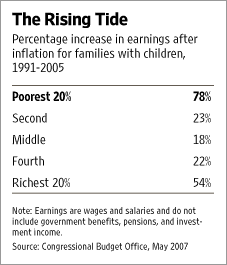
Well, you're not going to hear these numbers quoted too often in Dem circles, but here's what the Congressional Budget Office has to say about all that:

That's right. As the WSJ editorializes today, the poorest of the poor have shown the greatest income growth over the last 15 years -- a 78% increase.
What happened? CBO says the main causes of this low-income earnings surge have been a combination of welfare reform, expansion of the earned income tax credit and wage gains from a tight labor market, especially in the late stages of the 1990s expansion. Though cash welfare fell as a share of overall income (which includes government benefits), earnings from work climbed sharply as the 1996 welfare reform pushed at least one family breadwinner into the job market.
Re-read that: GOP programs, like the welfare reform the GOP forced Clinton to sign after he had dug in his heels against it, like low taxes that expand the economy and the earned income tax credit have worked.

Dems will focus on the 54 percent increase in income of the richest of the rich, condemning the GOP as they do, but you won't hear a one of them mention the 78% increase in the income of the poor.

Savvy readers will note that because the Dems have succeeded in turning the national debate to the needs of the poorest and the greeds of the richest, the middle class has missed out on much of this economy's largesse. The 20th, 40th and 60th percentiles have an average income growth of just 21% -- less than half that of the richest and barely more than a quarter that of the poorest.

Now, a 21% growth over 15 years beats what Carter could have done, but it's not great. If we're going to debate the economy at all -- I'd rather we just let it run itself, but what chance is there of that? -- we should stop the divisiveness of John Edwards and his fell Dems and look at everyone, not the extremes.

Labels: , ,