Cheat-Seeking Missles

Monday, March 24, 2008

Economics 101 For MSM, Hillary?

Adam Smith, cover your eyes. I'm about to reveal something that would be very upsetting to Mr. Invisible Hand, were he still with us.

AP, the world's largest news distribution service, and therefore, one would think, one of its best, led off a story on the housing market today with this gem:
After falling for six straight months, sales of existing homes posted an unexpected increase in February. But the median home price tumbled by the largest amount on record.
"But?!" Obviously, "because" is the right word. Anyone with even a modest understanding of economics knows that government programs and bailouts aren't going to be what starts bringing the housing market back. But lowering prices (and making more mortgage money available) will. In February we saw that: Prices dropped and people bought.

Meanwhile, Ms. Change (seen here signaling for eight more Clinton years), showed off that she's right there in the dunce's corner with AP, as she called for an "emergency working group on foreclosures" led by -- here's a new face -- Robert Rubin, her hubby's econ czar who helped the Clinton administration skate by on Reagan's robust economy almost until the end of Bill's second term, when it all collapsed.
Such a panel would recommend legislation and other steps to "help re-establish confidence in our economy," Clinton said in prepared remarks for a speech on the economy in Philadelphia. She and Sen. Barack Obama are campaigning heavily in Pennsylvania, which holds its presidential primary April 22.

Clinton also proposed greater protections for lenders from possible lawsuits by investors, a version of so-called tort reform more often associated with Republicans than Democrats.
Uh-huh. Washington DC can re-establish confidence in the economy; we all believe that ... just let us find our WIN buttons. And we're all sooo behind Hillary on her bright idea to stiff investors -- what do they do besides fuel the economy, anyway? -- in order to bail out financially dumb or greedy people who are stuck in bottom-of-the-barrel mortgages.

The failed mortgages are made up, in large part, of claimed income mortgages, and most of the failed claimed income mortgages are ones in which the relationship between the claimed income and the real income is tenuous at best.

In other words, they lied and Hillary cried.

Being used to covering for liars, Hillary wants to take care of these people so they can live to lie again. Why teach them a lesson when you can bail them out again and again, ensuring that they'll continue to vote Democratic?

Here's a better solution, and it's already done without the help of the junior senator from New York and her know-it-all buddies:
Government regulators are reducing capital requirements on Fannie Mae and Freddie Mac in a bid to add liquidity to the troubled mortgage market.

The Office of announced Wednesday that it has cut the government-sponsored mortgage investors' surplus capital requirement to 20 percent from 30 percent.

The office estimates that this reduction, in combination with the release of portfolio caps announced last month, should provide up to $200 billion of immediate liquidity to the mortgage-backed securities market, and allow Fannie Mae and Freddie Mac to purchase or guarantee about $2 trillion in mortgages this year. (source)
Unlike Democratic senators running for president, the housing market economists at the Federal Housing Enterprise Oversight understand that making more money available for mortgages will make mortgages cheaper and more plentiful. They also understand that this is a temporary fix, and capital reserve levels should return to 30% once things straighten out.

I am a part of the housing industry. I have seen many friends laid off and am watching as a couple friends hold on by their fingernails to their companies. It is not a good time for us -- but we all know that the last decade, which was incredible for the industry, would not have been possible if the already heavy hand of government were any heavier in our industry. So we also know that letting Hillary and her big government ilk have her way is not going to help in our recovery.

We were drunk in the good market and we're hung-over today. And no thanks, Hillary -- keep your snake oil hangover solution to yourself.

Labels: , , , , ,

Wednesday, January 16, 2008

Making Billions Off The Housing Slump

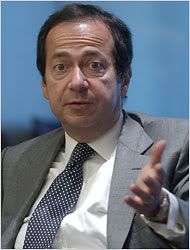
Ever heard of John Paulson? Me neither, but George Washington sure has, since Paulson made three or four billion Washingtons last year -- and his hedge fund made $15 billion -- by betting against housing. While others wallow in misery as their over-leveraged houses go into foreclosure, or as they look for new jobs outside the mortgage industry, Paulson is luxuriating in their misery.

WSJ subscribers can read the story here (non-subscribers can read an NYT piece on Paulson here). Here are the basics:

In early 2006, while most thought the housing market and its closely affiliated mortgage market could suffer a downturn but not a collapse, Paulson saw things differently and decided to bet on a collapse.
In several interviews, Mr. Paulson made his first comments on how he made his historic coup. Merely holding a different opinion from the blundering herd wasn't enough to produce huge profits. He also had to think up a technical way to bet against the housing and mortgage markets, given that, as he notes, "you can't short houses."
Among the ways Paulson accomplished this were to "short risky CDO slices" and to "buy the credit-default swaps that complacent investors seemed to be pricing too low." Got it? I don't.

Paulson's been a successful investor for a long time, and he did what investors do. Most of us prefer folks who see a market need and fill it more than we like those who see a market weakness and exploit it, but it's all capitalism.

As he has before with earlier, smaller, killings, Paulson will invest his winnings back into the market. I suggest he use a part of it to help lift the housing market back up. That won't only benefit a lot of people, it will also allow him to pull off the nifty trick of profiting off a market as it falls, and again as it recovers.

Labels: , ,

Wednesday, December 12, 2007

A Welcome Global Move To Ease Credit

News of a global effort to ease the credit crunch is welcome, indeed, and far superior to the President's dangerous, unfair and inequitable proposed solution to the mortgage meltdown.

Over the last couple days, I have spent hours with the leaders of Southern California's home building industry. (Although I can hardly drive a nail, I guess I'm a leader of the industry as well, as I serve as public affairs VP for the industry's So Cal trade association, the largest and most watched in the nation.)

To a person, they are pessimistic for the short term and ebullient for the long term -- from perhaps 2010 on. All of them predicted a downturn and were preparing for it, but none anticipated the precipitous drop created not by a lack of demand but by a lack of credit.

How precipitous? Last year, new home sales and remodels in So Cal had a value of $17.9 billion; this year, it will be $5.5 billion less, according to the Construction Industry Research Bureau.

Adversaries in the no growth movement (the Greenies, Warmies and NIMBYs) may be desirous of a crumbling economy, or they may be ignorant, but if they are celebrating housing's stumble, they should know the price: The So Cal economy took a $12 billion hit in 2007 because of the drop.

Since the market adjustment started in 2004, SoCal's economy has lost $38 billion in economic activity that were lost as the value of new homes, remodels and new business activity created by them shrunk, according to CIRB.

This is the largest new home market in the country, but numbers of such a scale are cropping up in nearly every market across the country. As goes housing, so goes America's economy.

That's why this news from WSJ is so encouraging:
The Federal Reserve has joined with four other major central banks to announce a series of measures designed to inject added cash into global money markets in hopes of thawing a credit freeze that threatens their economies.

The Fed said today it would create a new "term auction facility" under which it would lend at least $40 billion and potentially far more, in four separate auctions starting this week. The loans would be at rates far below the rate charged on direct loans from the Fed to banks from its so-called "discount window." But the new loans can still be secured by the same, broad variety of collateral available that banks pledge for discount window loans.

The European Central Bank, Bank of England, Bank of Canada and Swiss National Bank simultaneously announced parallel measures.

Stock futures soared Wednesday on the news, a day after the Fed's rate moves disappointed the market.

The Fed also said it had created reciprocal "swap" lines with the European Central Bank, for $20 billion, and the Swiss National Bank, for $4 billion. These will enable the ECB and SNB to make dollar loans to banks in their jurisdiction, in hopes of putting downward pressure on interbank dollar rates in the offshore markets, principally the London Interbank Offered Rate, or Libor, market. The inability of foreign central banks to inject funds in anything other than their own currency has been a factor creating the squeeze on bank funding in those markets.
Because home sales today are not so much for homes, but for deals, stabilization is the first step toward recovery. As long as buyers remain reticent to close a deal because they think tomorrow will bring a better deal, sales will continue to drop.

The Fed's move, by freeing much-needed new sources of credit, can bring new buyers into the market, and builders were working to diminish their standing inventory over the last couple of years, it won't take too many sales before supply and demand achieve equilibrium.

With all the expected disclaimer, investors might want to start looking for deals in homebuilder stocks. There are risks of bankruptcies in the short term, of course, but the companies that make it through should begin appreciating quite robustly in a few years, thanks to moves like the Fed's today.

Labels: , ,

Friday, August 24, 2007

Bin Laden Beaten ... By Bad Mortgages

Osama bin Laden might be one bad dude, but he's not as tough as a crummy mortgage:
NEW YORK (AP) - Bad credit has supplanted terrorism as the gravest immediate risk threatening the economy, a key national research group reported Monday.

Borrowers' withering ability to pay their bills and the subsequent fallout in the credit markets this summer topped the list of short- term risks on peoples' minds, according to a survey of 258 members conducted by the National Association of Business Economics.

Of course, the key words here are "short-term risks," which are certainly not good qualifiers for jihad-risk. Jihad-risk did rate number one when NABE last surveyed its members back in March when things were going along a bit more swimmingly in the economy.

Despite the economists' pessimism about the current lending-fueled economic heebie-jeebies, they do believe it's a short-term situation and things in the housing market should be back to normal in five years (my sources in the building industry say four years; I hope it'll be less) .

Unfortunately, unless things take a miraculous turn, jihad will still be a threat to our economy and our safety then.

Very cool illustration: Jan Op de Beeck

Labels: , ,