Cheat-Seeking Missles

Wednesday, January 30, 2008

Creationism Bragging Rights
Did you know a "giant step" has been made in scientific efforts to create human life?

Yes, indeed! We are truly on the doorstep of designer life from scratch ... at least that's true if you're not paying careful attention to the bombastic claims of some scientists. Unlike the SF Chronicle, which bought the story hook, line and genome:
American scientists have built from scratch a synthetic chromosome containing all the genetic material needed to produce a primitive bacterium - a giant step toward the creation of artificial life. ...

Now, a team led by Dr. Hamilton Smith, director of the Venter Institute's Synthetic Biology Group, has manufactured from laboratory chemicals a ring of DNA containing all the genes of Mycoplasma genitalium - the tiniest bacteria ever found.

That means the team is tantalizingly close to creating an artificial form of life that could replicate itself using these machine-made genes.
The article mentions curing disease and all the usual promises of mad scientists, then cuts to the chase:
And there is the matter of bragging rights of mythological proportions. Mere mortals have yet to lay claim to creating life.
Yeah, and that's a good thing, if you ask me or nine out of ten science fiction writers. Why exactly would we want to produce artificial life? Is there something wrong with God-created life? Do we really think we can do any better?

Never mind with the metaphysical questions, though, because it turns out that Dr. Smith is hardly creating artificial life:
The plan is to slip the synthetic chromosome inside the microscopic skin of one of the Mycoplasma bacterium, replacing its natural genome with the machine-made one and sparking the creature into a life form that can reproduce itself.
He may be hijacking actual life, but he's not creating anything sustainable from scratch if it takes having a Mycoplasa bacterium handy to pull of the trick.

It all reminds me of what is, perhaps, the greatest of all creationist jokes (not that there is exactly a primordial sea-full of creationist jokes, mind you).

A scientist waves his arm at his massive lab of sophisticated equipment and says to God, "Human intelligence is now so great and our understanding of science so comprehensive that I, too, can create life."

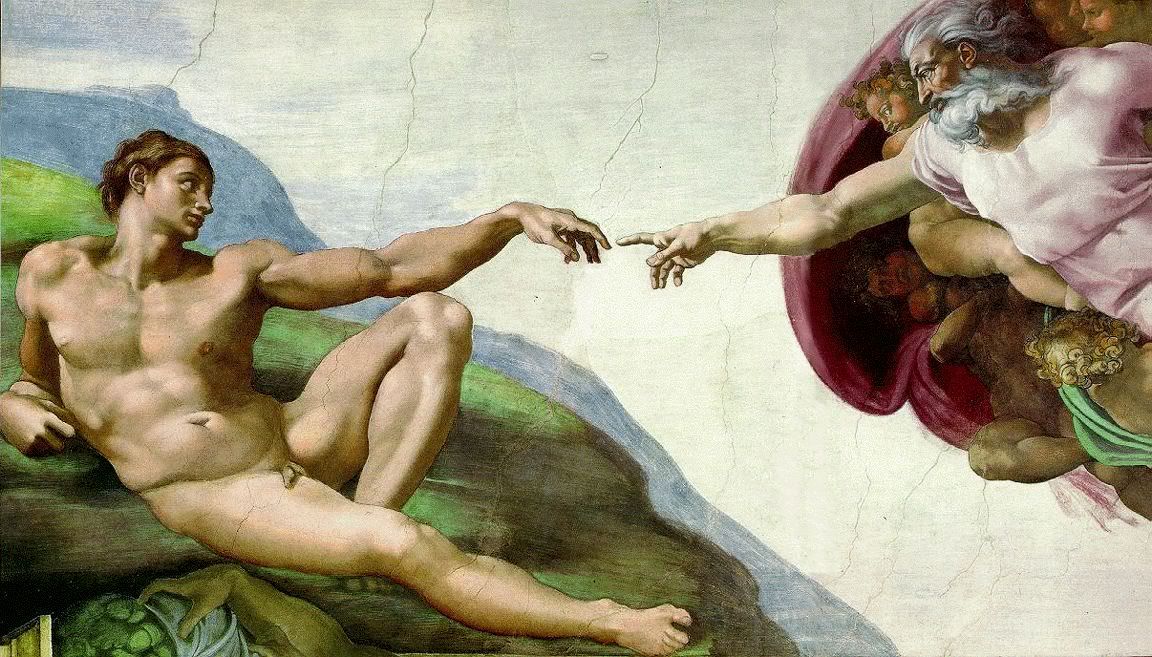
Unimpressed, God reaches down, takes a lump of dirt, breathes on it, and transforms it into a butterfly that flutters from his hand.

"That's nothing!" brags the scientist. "I too can make a butterfly!" He reaches down to get a piece of dirt.

"Hold it right there," God says. "Make your own dirt."

Make your own host bacterium, Dr. Smith. The chromosome was a nice trick, but let's not lose our perspective, eh?

Labels: , ,

Friday, August 31, 2007

Beethoven Redux

With its thunderous, soaring highs, its sweet, subtle lows, and its glorious cry of praise and wonder to God, who could imagine the Ninth Symphony of Beethoven was composed by a deaf man?

It is perhaps the foremost wonder of the world of art. Forever, man will ponder the heart of Beethoven as he confronted his deafness, and confronted his God in light of his deafness, and then went on with his gift by simply (and most likely angrily) listening to the sounds within.

In today's WSJ (subscribers only), Janet Adamy tells a modern parallel story that leaves one breathless:

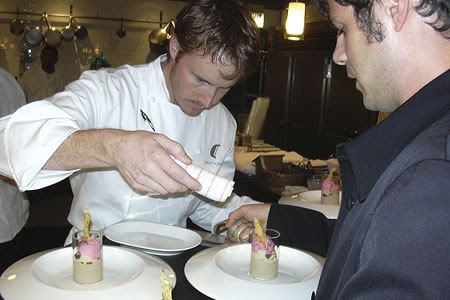
A year after chef Grant Achatz opened Alinea [in Chicago] in 2005, Gourmet magazine named the restaurant the best in the country, and the prestigious Mobil guide gave it its highest rating of five stars. The young chef's exotic, lavishly presented creations -- a mango duck dish is served on a deflating pillow that releases lavender-scented air -- have connoisseurs lining up to book meals that cost an average of $240 a person.

But last month, doctors gave Mr. Achatz, 33 years old, devastating news. A cancerous tumor was growing inside his tongue. The disease was so advanced that three doctors told him the only way to cure it was to cut out part of his tongue, leaving one of the world's most celebrated chefs to ponder life without the ability to taste.

Achatz (pronounced ACK-etz) is feeling not only intense pain, but certainly must also feel the intense irony of his disease. His tongue is so swollen and painful, he can't eat. Already a trim young man, he has lost ten pounds.

Let's take a moment, though, to consider the Beethovenesque creativity of Achatz:

In 2004, Mr. Achatz detected a tiny sore growing on the side of his tongue. A dentist told him it was probably from unconsciously biting at the spot, and fitted his mouth for a night guard. That year, he left Trio to open his own restaurant in Chicago's tony Lincoln Park neighborhood.

He decided to call it Alinea, after the name for a typographical symbol that indicates a new train of thought. His ambition wasn't only to present his food as art, but to make the entire dining experience into a form of theater that would appeal to all of diners' senses and elicit emotional responses. For instance, Mr. Achatz had an architect design Alinea's entrance so that people would walk in, not be able to see the dining room and briefly think they were someplace other than the restaurant, creating a moment of tension.

As soon as Alinea opened in 2005, critics began heaping praise on the hypermodern cuisine and eclectic dining experience. Meals consist of as many as 30 small courses and have taken diners more than seven hours to consume.

To evoke autumn, Mr. Achatz served a piece of pheasant breast on an oak-tree branch lit on fire so it would be smoking as it arrived at the table. For a dish called "Hot potato, cold potato," Mr. Achatz skewered a marble-size potato and suspended it over a paraffin wax bowl of chilled potato soup so the palate would sense the temperature contrast.

One can imagine a parallel tension, like the one he created in his restaurant's doorway, as Achatz dealt with the increasing pain at the doorway to his sense of taste. As his success and fame grew, so did his inability to, quite literally, taste the fruits of his success.

Adamy only quotes Achatz twice in her story, once on the discovery of the tumor, and once on his one day of brooding before setting out for an alternative to surgery.The alternative is questionable, involving new chemo medications and radiation, but if it works, he'll return to Alinea with all his senses, including taste, about him.

Even if he doesn't, those who know him think he could become the Beethoven of chefs:

Dr. Vokes says it's too early to predict exactly what might happen if doctors removed the tumor from Mr. Achatz's tongue. Typically, removing a significant part of the tongue leaves a patient unable to taste and interferes with his or her ability to speak and to swallow. The sense of smell isn't usually affected.

But other senses contribute to Mr. Achatz's talent. Much of his acclaim derives from the way his dishes look. Before he cooks a new creation, he writes down the ingredients he wants to use and how he'll manipulate them. Then, he sketches what it might look like on the plate before discussing it with the chefs who work under him.

"He has such a spiritual connection with food and the visuals, and the taste is just a part of it," says Rick Tramanto, executive chef at Tru in Chicago. "He's way too connected to what he's doing to have [a loss of] one of the elements deter him at all."

God grants us gifts, but does not guarantee them. Whether the gift is a talent like Achatz's, or a child, or a fortune, we must always remember that they may be temporary. Losing them may destroy us or may make us stronger, more resolute, more directed, more able to create our smaller personal version of the Ninth.

Will Achatz be gifted with a lifetime of taste, or will the sense be like the puff of lavender air from one of his creations, here for a moment, then gone as a fragrant memory?

That is not really the question. The question is, will Achatz, will we, keep our will strong in the face of adversity? Will we focus not on our pain, but on the wonder that we had the gift in the first place?

Photo: Janet Adamy, WSJ

Labels: , ,