Cheat-Seeking Missles

Tuesday, June 10, 2008

California's Coast-Nazis Attempting To Ban 4th Of July Fireworks

John Adams, in 1776, wrote to his beloved wife Abigail:
"[Our Country's] foundign ought to be solemnized with pomp and parade, with shows, gaves, sports, guns, bonfires, and illuminations from one end of this continent to the other from this moment forward forever more."
Don't tell the staff of the California Coastal Commission, which is working diligently to forbid fireworks shows on this particular end of the continent.

Tomorrow, at its meeting in Santa Rosa County, the Commission will consider a staff-issued Cease and Desist order against the tiny northern California coastal town of Gualala, which celebrates the Gualala Patriot Day festival, complete with a 10-minute fireworks show.

Note: The hearing will be webcast live! Log onto the Coastal Commission Web site and follow the link on the home page.

As the Commission's agenda puts it:
13. Commission Cease and Desist Order No. CCC-08-CD-07 (Gualala Festivals Committee, Gualala, Mendocino County.) Public hearing and Commission action on proposed Cease and Desist Order directing the Gualala Festivals Committee to cease and desist from undertaking or threatening to undertake development without the necessary coastal development permit, including, but not limited to, conducting a fireworks display over the Gualala River estuary or 39170 South Highway One, Gualala, Mendocino County (APN 145-261-12) (NC-SF)
"Development" is a strange way to refer to a fireworks show, eh? That's because to wring a fireworks ban out of the California Coastal Act, the Commission would have to call the show "development." Staff is up for the challenge:
The unpermitted activity includes the placement of solid material on land [temporary fireworks launchers] and the discharge of gaseous and solid waste into coastal waters and constitutes an change of intensity of use of both land and water or access thereto, and therefore constitutes "development" as defined in Section 30106 of the Coastal Act, as discussed fully herein.
Note that in the Commission's view, not only this tiny, temporary impact "development," and therefore illegal, just "threatening" to do it is illegal as well. Apparently the 1st Amendment has been suspended in California's Coastal zone.
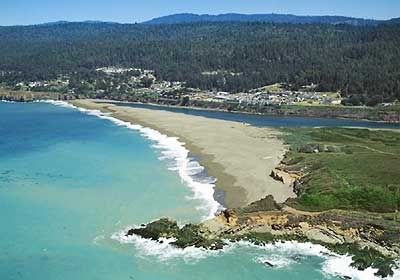
Why does the Commission staff have its biodegradable panties in a knot over a ten-minute fireworks show in sleepy Gualala? First, because the Commission is chartered to protect public access to California's public beaches (that would be every single beach from Oregon to Mexico), so:
... the launching of fireworks will temporarily disrupt public access to and along the Gualala Bluff Trail prior to and during the fireworks display by closing a portion of the Gualala Bluff Trail to the public.
Never mind that it's at night, when people aren't really safe walking coastal bluff trails. Never mind that the Gualala Patriot Days celebration attracts hundreds of people to the coast, thereby syncing up with the Commission's charter.

Also, attached to the staff report is a 47-page report from the federal Bureau of Land Management and U.S. Fish & Wildlife Service with the snappy title, Seabird and Marine Mammal Monitoring and Response to a Fireworks Display at Gualala Point Island, Sonoma County, California, May to August 2007.

Yes, the full authority of the federal government -- bolstered by your tax dollars, a portion of which actually went to fund this monstrosity of a study -- is behind Coastal staff's efforts to quash firework displays on the California coast.

Using the report, staff argues that:
The fireworks will affect environmentally sensitive habitat and marine and water resources. The Gualala River Estuary is a breeding ground for threatened Coho salmon and steelhead trout as well as other local fish.
The report monitors birds, not fish, and presents no evidence that fish or fish breeding was affected by the fireworks display. Salmon migrate during daylight hours anyway. I imagine trout follow suit, or trout fishing would be a night-time sport.

Then the report turns to the ospreys, great blue herons, egrets, and river otters that fish in the river and its estuary, and the marbled murrelets, and endangered species, live in the area. None of these is nocturnal.

It then brings up the Pacific Flyway, saying the Gualala Estuary provides an essential habitat for feeding, perching and nesting. Except that in July, there isn't any traffic along the flyway -- migration occurs in the spring and fall.

Undaunted, Coastal staff soldiers on:
As discussed more fully herein, a similar fireworks display occurred in approximately the same location last year and had a demonstrated adverse effect on the nesting birds, including most likely causing actual nest abandonment and consumption of abandoned eggs and/or juvenile chicks by predators, a permanent impact .... (emphasis added)
The nests and eggs in question were not those of any endangered species, so the Commission has no authority to regulate them. Even if some juveniles of plentiful bird species got eaten as a result of fireworks, I say, it was for a good cause. Look at Google Maps, and you'll see that Gualala is a tiny speck against the vast emptiness of the California coast, so any impact its fireworks might have would be minuscule in the scheme of things.

But that didn't stop the mighty federal government from trying against all odds to prove an impact, with agents crawling around Gualala's rocky shores, armed with digiscoped and infrared cameras. Their report:
... Brandt's Cormorants quickly changed from resting to erect postures at the first fireworks, followed by birds moving about or departing the island. Western Gulls also flushed, circled and called during the fireworks display.
The horror! The report then says that of 90 cormorant nests, seven were abandoned between July 5 and 7, with some additional abandonments following ... all "likely" resulting from "fireworks disturbances." I asked a biologist friend about this, and after pointing out that Brandt's cormorants are not a listed species, he said that amount of nest abandonment did not seem unusually high.
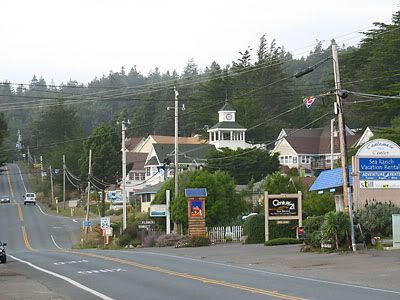
So, armed with a "likely" and a "most likely," the Army of Gaea is assaulting a great American tradition as it is played out in a quaint, remote coastal California town. It's part of an assault on fireworks shows that has consumed the Commission staff for years, but thus far, the Commission has corralled their staff's shameless attempts to destroy a great, patriotic American tradition exuberance.

The Pacific Legal Foundation is standing poised and ready to fight, and the Festival's attorney, Keith Faulder, filed an impressive brief, which is included in the staff report, starting on page 56. Faulder is not above a jibe or two:
The citizens of Gualala love their small community, their river, and their coast. The people of Gualala, as rugged and independent as the land in which they live, have been taking care of their community and their environment since the 1860's, with very little help during that time from any county, state or federal agencies.
This is truly the case of the little, freedom-loving guy up against the freedom-crushing power of a PC, Greenie bureaucracy that answers to no one and is, therefore, running amok.

Tomorrow's hearing promises to be spirited. Remember, you can follow the progress on line by logging onto the Coastal Commission Web site and following the webcast links at the top of the page. The session starts at 10 a.m. Pacific time, so my guess is the Gualala cease and desist order will come up around lunch time ... but don't hold me to that.

Labels: ,

Sunday, July 01, 2007

Tahoe Residents Seethe At Greenies

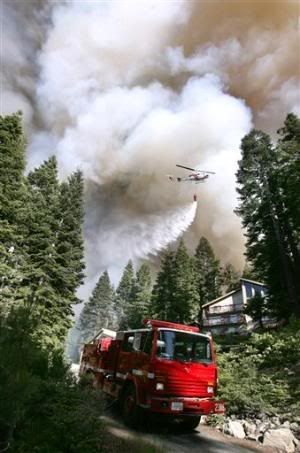
Richard Carlson looks out his Tahoe cabin window at the beautiful view knowing that if he sees forest fire smoke below him, he has 10 minutes to clear out before the fire will block his only exit route. Carlson therefore knows a thing or two about managing forests for optimum fire safety. Why?

Behind my home, it's nearly impossible to hike off trail because you have to wade through knee-deep piles of dead branches.

The forest is ready to explode. We have too many trees, but no one dares do anything about it.

It's not a pretty thing, this forest management debate. Lumber company and radical environmentalists have staked out the extreme positions, with the Forest Services, forest residents and mainstream conservationists in between.

Reasonable people know the forest has to be thinned. People educated on the matter know that when the first photographers lugged cameras up the Sierras, the photos they took showed forests remarkably thinner than those today. And environmentalists know they'll always be able to make a buck by railing against loggers.

Against that backdrop, an agreement was struck to allow the sort of environmentally balanced thinning that might have prevented the Tahoe fire. It didn't pan out, says Carlson in an SF Chronicle opinion piece today:

Effective but environmentally safe forest thinning requires compromise between environmentalists and commercial loggers. Unfortunately, the new, more ideological environmental movement refuses such compromise. This refusal is exemplified by the Quincy Library Group.

The group drafted an agreement among Sierra conservationists, industry and political leaders that would have allowed enough controlled commercial thinning of Sierra forests to actually make a dent in the deadly growing forest fuel loads. The agreement was killed by lawsuits from the new, more radical urban environmentalists who value money and ideology above science, homes and human life.

The leaders of such groups as California's chapters of the Sierra Club knew that their urban constituencies could be depended on to contribute to any anti-logging campaign.

Compromise would lose money and support to more-radical groups. Having spent decades creating the image of the evil logger as their favorite fundraiser, the urban environmentalists didn't dare be caught talking to one. Allied as the Sierra Forest Legacy, these organizations have largely stopped effective efforts to deal with the fast-growing fire danger in Sierra forests.

It's not like there hasn't been sufficient time to implement the recommendations of the Quincy Library Group's agreement; it was inked in 1993, and DiFi submitted legislation in 1998. But nothing has happened except more of the insane status quo:

While the lawyers argue, and the environmental fundraisers happily collect their tribute, the forest fuel loads keep growing.

In Tahoe, the situation is exacerbated by the Tahoe Regional Planning Agency (known locally as the Tree Nazis). The agency's rules override fire marshal guidelines and generally make desperately needed tree thinning impossible. Unless you go through an insanely complex, expensive and lengthy permit process, you can't touch a tree that's larger than 6 inches in diameter, even if it's next to your house. And 6- to 12-inch firs are exactly the type of tree that is the greatest fire danger.

It's the same all over, and not just with the fires that preceded in Arizona and elsewhere. The California Coastal Commission forbids the repair or building of sea walls. A farmer in San Bernardino County was arrested for plowing a fire-break around his home because Stevens kangaroo rats might have been disturbed.

One of my clients recently spent $3 million fighting off (successfully) a Center for Biological Diversity lawsuit over air quality. Ironically, the project was able to fully mitigate its air quality impacts for one-sixth that amount, just $500,000, with which they bought new, clean diesel generators to replace dirty generators used by farmers in the area.

The Center didn't care. This client is a major fundraising source for them and like radical green groups everywhere, solutions aren't their goal; power and money is.

If people die and cabins burn because of their goals, so what? The world in their view is better without people and cabins anyway.

Labels: , ,

Saturday, June 30, 2007

Tahoe Burn: Regulatory Nightmare Without End?

The cause of the devastating Lake Tahoe fire, which burned down 200 structures causing hundreds of millions of dollars in damage and who can measure how much heartbreak, has been found.

It is the Tahoe Regional Planning Agency (TRPA), a bi-state land czar bureaucracy dedicated to protecting the clarity of Lake Tahoe at all cost.

Among TRPA's passions is imposing maniacal restrictions on cutting trees because ... follow the logic ... a gone tree means more exposed soil (i.e., the area where the trunk once was), which would mean more sediment would run into the lake. So cut a tree in Tahoe and look at thousands of dollars of TRPA fines, which TRPA uses to find more people to fine.

Nevermind that tree branches shade the ground, limiting ground cover and that tree trunks absorb no groundwater; that's their position and they've stuck to it. Of course, there was this one minor negative side-effect: Homeowners couldn't cut trees near their homes, those trees caught fire, and voila, no more house.

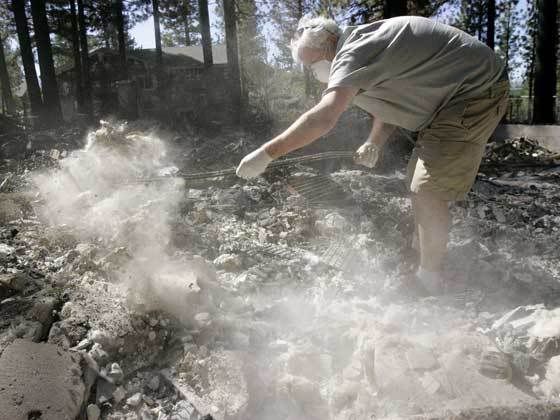
Now that so many trees and houses are gone, rain and snowmelt will have hundreds of bare, disturbed acres like those in the picture, to run off, pummeling Tahoe with silt and ash. Nicely done, TRPA; a shining example of just how stupid environmental bureaucracies can be.

TRPA's executive director, John Singlaub, says the agency does allow trimming around homes, but the message just didn't get out. Well, whose fault is that? The OC Reg reports people aren't buying Singlaub's line ... or his attitude:

"I thought our message was out there better," Singlaub said "I was not expecting this."

Singlaub was less conciliatory during his first explosive encounter with the public at a town hall meeting Monday, when the blaze was still tearing through forests south and west of the local commercial hub of South Lake Tahoe. Many in the crowd of about 1,200 booed and shouted down a defiant Singlaub as he tried to defend the TRPA's policies.

Two days later, when he resurfaced to tour the destruction with Gov. Arnold Schwarzenegger, local reporters and town leaders interrupted the governor's news conference to pepper the TRPA director with questions.

What is TRPA's vaunted new leniency? It allows homeowners to clear pine needles all the way to five feet from their homes. Any more will mean too much erosion, they say, and big trouble. Not all homeowners went along with this rule ... and they were the lucky ones:
"I went around my whole property and took out every single pine needle," said Neil Cohn, 35, pointing to a blackened line where the advancing fire that destroyed eight of his neighbors' homes stopped short of his own. "TRPA came up here last year and gave me a warning but I did it anyway, and I'll keep doing it."
After all this, Singlaub is unbending: preserving the lake's clarity is still job number one for TRPA, he says.

That's absolutely true. Following the fire, TRPA may be talking big about fire protection, but a review of the executive summary of the agency's 2006 Threshold Evaluation, basically an annual report, finds lots of talk about water quality and runoff control, but a search for "fire protection" yielded no results.

My heart goes out to homeowners who lost their homes, not just for their loss, but because they have only entered the nightmare; they're hardly over it. In the years since their homes were built, TRPA has screwed down the regulatory thumbscrews and what was permissible then will not be approved now. And pity the poor soul who attempts to add even one square foot to his home during rebuilding. They will be burned in a firestorm of regulatory paperwork -- and ultimately denied, I'll bet.

I predict something of a range war in the Tahoe area in coming years as residents who love and have protected the land there for years are told by TRPA that their plans for rebuilding just can't be approved. TRPA caused the fire, now they're going to cause the political fire that will follow.

But let's not over-demonize TRPA. It is not that much worse that land czar bureaucracies from sea to shining sea. These agencies have been completely overrun with hardcore, anti-development environmentalists -- Singlaub says humans degrade the environment "just by living here" -- and their agenda is to push us out of the areas they regulate.

The policy train has wrecked in Tahoe. Will the land czars be able to get it back on track, or will be people demand real change? My bet, sadly, is on the land czars.

Labels: , ,

Friday, April 27, 2007

The Effects Of Regulation On Blogging

My only other post so far today was at 7:34 a.m., almost 12 hours ago -- highly unusual. Blame it on the California Coastal Commission.

I have a client that has been trying for 4 1/2 years to get a hearing before the Commission. The staff asked for study after study forcing delay after delay. Twice we've been scheduled, only to be postponed, once because staff wasn't ready and once because ... well, I'd best not say, but it had nothing to do with our team's willingness to proceed.

Now, we're scheduled to appear in May, and my client has asked his core consulting team (three biologists, two engineers, one flood expert, one lawyer, two Coastal Commission lobbyists, one groundwater hydrologist and me) to be available for meetings from 8:30 to 5 every week day until our hearing on May 10.

"We'll see about weekends, based on how well we're getting through everything," he joked (I hope) when setting up the meetings.

Even after 4 1/2 years, there is enough to do that we're challenged to get it done before the hearing.

What are we proposing that takes so long and requires so much? A nuclear power plant? The dredging of virgin reefs? The creation of a massive new harbor?

No, just one residential neighborhood.

If we get approval of the number of homes I expect we'll end up with, the cost of preparing for our Coastal hearing will add perhaps $25,000 to the cost of each home -- on top of the $125,ooo per home in public benefits and infrastructure improvements the developer has already agreed to pay in order to get approved.

And you wonder why homes in coastal California are so expensive!

Anway, expect light blogging on weekdays for the next couple of weeks.

Labels: