Cheat-Seeking Missles

Wednesday, June 11, 2008

Admitting Defeat In The Rhetoric War

Another famous American has followed in the footsteps of the Dixie Chicks, Susan Sarandon and a host of others to choose a foreign venue to bad-mouth Bush.

This time the guilty party was ... George W. Bush.

In an interview with the Times of London, Bush said he regretted the tone of his rhetoric in the early days of the war, believing it has led to a misunderstanding of America and its motives.
President Bush has admitted to The Times that his gun-slinging rhetoric made the world believe that he was a “guy really anxious for war” in Iraq. He said that his aim now was to leave his successor a legacy of international diplomacy for tackling Iran.

In an exclusive interview, he expressed regret at the bitter divisions over the war and said that he was troubled about how his country had been misunderstood. “I think that in retrospect I could have used a different tone, a different rhetoric.”

Phrases such as “bring them on” or “dead or alive”, he said, “indicated to people that I was, you know, not a man of peace”.
As a communicator, I couldn't agree more. Those phrases felt good at the time. We had just been beaten up by a rancid slug in a turban and we were angry and embarrassed. Bush talked tough and it made us feel better, and we needed to feel better, but it set a tone inappropriate for a real war.

Fifty-four years earlier, America was beaten up, bruised and embarrassed, and the president at the time, FDR, took to the airwaves with his famous "day of infamy" speech. He measured out his rhetoric much more carefully, careful to set a tone appropriate for the horrific task that lay ahead. He knew thousands of our military had already died at the hands of the Japanese, and that tens of thousands more would likely fall in the war to follow, yet these were the most pitched lines of the speech:
Japan has, therefore, undertaken a surprise offensive extending throughout the Pacific area. The facts of yesterday speak for themselves. The people of the United States have already formed their opinions and well understand the implications to the very life and safety of our nation.

As commander in chief of the Army and Navy, I have directed that all measures be taken for our defense.

Always will we remember the character of the onslaught against us.

No matter how long it may take us to overcome this premeditated invasion, the American people in their righteous might will win through to absolute victory.
Granted, "bring 'em on" was the low point in some lofty rhetoric Bush delivered in the days following 9/11, and at the initiation of the wars, but presidents have to be careful in what they say because history selects the words the world will remember. FDR chose words that set the stage for a righteous battle against an infamous foe; Bush sounded like a schoolyard thug.

The communications failures of the Bush administration are legion and will not be fixed in the final six months of his term. He not only framed our effort unfortunately, he allowed far too much illegitimate criticism to go unchallenged -- especially the criticism of the Dem congress and American hardcore left.

By the time Bush became passably adept at framing the consequences of the Dems' approach to the war, his style had already turned too many people off, so his speeches lost much of their power to influence.

Finally, Bush appears to have bought into his "dead or alive," "bring it on" rhetoric, as evidenced by the careful planning and strong execution of the first phases of both wars, and the failure to anticipate the difficulties to follow.

We are in a quandry. The candidate with the rhetorical powers to patch things up has the wrong policy, and the candidate with the right policy is perhaps even worse rhetorically than Bush. McCain might want to make his #1 qualification for running mate "soaring rhetorical power."

Labels: , ,

Wednesday, May 28, 2008

McClellan Proves The Need For The Odd Press Secretary Model

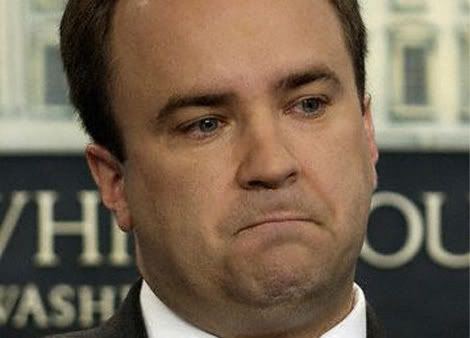
Scott McClellan, former presidential press secretary turned turncoat with the publication of his memoir, has quite a publicity storm around him this morning. Here are the links under the lead McClellan story this morning on memorandum:
The Swamp, Attackerman, Newshoggers.com, The Corner, MSNBC, Too Sense, Daily Kos, Political Machine, Discourse.net, Outside The Beltway, On Deadline, Redstate, Brilliant at Breakfast, Informed Comment, Hot Air, Don Surber, THE GUN TOTING LIBERAL™, Emptywheel, Washington Monthly, Pam's House Blend, Facing South, David Corn, The Raw Story, Jules Crittenden, I Am TRex, Crooks and Liars, Romenesko, The Moderate Voice, Donklephant, Oliver Willis, The Reaction, Political Byline, The Washington Note, First Draft, Liberal Values, KIKO'S HOUSE, Connecting.the.Dots, Alternate Brain, Salon, The Art of the Possible, RADAMISTO, Macsmind, Political Punch, Rising Hegemon and Taegan Goddard's …
You can certainly read them, but they boil down to this: Everyone on the left says McClellan vindicates everything they believe about President Bush, Karl Rove and Scooter Libby; everyone on the right says he's a cheap sell-out. That's not what I'm writing about, per se.

Rather, I'm writing about McClellan's job. Not his job performance, which Seth Liebsohn nails down pretty well at The Corner, but his job.

In many ways, it's like my job. I am often the public spokesperson on a project, but my job is different from McClellan's old gig in that I don't allow myself to be kept in the dark so that my comments can be limited and my deniability can be plausible. I believe the role of the communications consultant is to understand all the facts and work with the client team to determine how best to present them, both immediately and over time.

Of course, the job of White House Press Secretary also is not at all like my job. There's much more interest in his client; there are many, many more stories; the press is never avoidable, and most importantly, the stakes are exponentially higher. That's why the typical and tested White House model is to have a senior circle -- consider it too simply as President Bush and Rove -- and an junior circle that is briefed fully enough to communicate what the senior circle decides.

Would I take such a job, one that sets me up to periodically be a fog machine on the truth? I certainly wouldn't in the private sector, or for any government position short of a national security position like McClellan's. To take a press secretary job at the White House, CIA, State or Pentagon means that you understand your role as a distributor of designer information. And that means that after you leave, you don't write a book complaining that you may have misled the media. Of course you misled the media.

McClellan did more than attack Bush; he attacked the position of White House Press Secretary, making it unlikely the Press Secretary will ever be admitted into the Senior Circle, for good reason. And in the process, he underscored the unseemly character of his work.

One of the major blabs in McClellan's book has to do with the Plame Game, and the actions of Rove and Libby. Off limits. National security. McClellan can point to the legal battles and the Leftist lingo, but as a former White House official, he should see this matter is now tied up in the war debate, and since the administration is in office and the war is still going on, there is nothing at all that he should say about it.

His writing on Katrina has nothing to do with national security, but he still shouldn't be writing it because he accepted a job that entailed an understanding of his position not just while he was on the payroll, but after -- again, at least as long as the current administration is in office.

His is the worst kind of sell-out. We gather no new information from him because he is a junior level guy who (by smart design, it turns out) wasn't in the information loop at the senior levels. So we read his opinion about how the administration blundered in handling the war. McClellan has no meaningful perspective to offer there because he was on the tail end of the info-trian.

And we read that he thought the picture of Bush surveying the Katrina damage from Air Force One was a bad idea, but he was overruled. Interesting and correct -- but if the price we have to pay for it is having him undercut the administration for 30 pieces of silver ... well, let's just say that McClellan illustrates the necessity of the senior tier/junior tier model.

Labels: , , ,