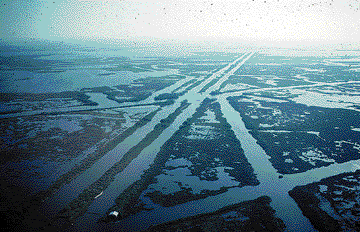
Happy? Earth Day
 I remember the first Earth Day back in the 70s, when we worried about the imminent risk to the earth caused by pollution. Now, nearly four decades later, we are supposedly still worried about the imminent risk to the earth caused by pollution.
The pollution has changed; the worry has not, even though it's clear there are lessons to be learned from year after year of hysteria: The earth works on its own long cycles, not our headline-grabbing short cycles; the earth is a lot more resilient than Greenie fundraisers would like you to believe, and finally, Greenies have gotten more successful at promoting environmental hysteria.
The evidence for each of the three is self-evident and needs no further explanation here. Instead, I'd like to praise the Greenies for a moment.
Don't get me wrong; I'm no fan, primarily because from top to bottom, the movement knowingly sensationalizes and distorts for self-benefit, which appalls me since I believe public discourse requires the level playing field truth provides. Worse, their solution is always larger government. They are anti-capitalist, anti-corporate and completely untrusting in the character of man, trusting instead in the fumbling, power-corrupted auspices of government.
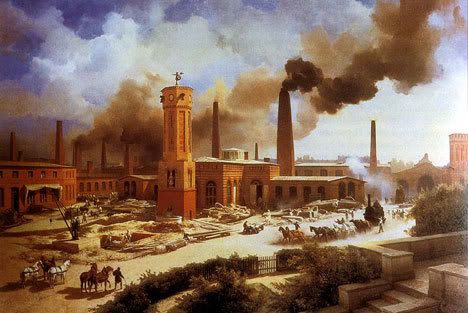 Yes, capitalism lead the world into the industrial revolution and pollution, but government went along with it and in time communism proved itself far more capable of blindly destroying natural resources than capitalism. The Greenies have forgiven government and big social programs, but have never forgiven capitalism, even though today it is the leading force that's creating the technologies that are taking us away from our polluting past.
But I still praise the Greenies because at their core they are conservationists, as am I. Conservationism is a biblical concept rooted in God's decree that we be stewards of his creation, and it holds as true today as it did with Adam and Eve. So while I make a living fighting environmentalists who try to stop new homes and infrastructure, and think their positions in these battles are untenable and do not represent stewardship, I look at the results of the fights and am not too upset at all.
My firm has been involved in programs that have set aside over 350 square miles of open space in return for development rights. That's more open space conservation than any environmental group has accomplished, as far as I know. Today, I'm working on one project that will preserve 1,600 of its 3,000 acres, another that will build on just under 12,000 acres and preserve just over 12,000, and a third that will permanently protect 21,000 acres, building on just 5,000 acres.
And the built environments within these projects are becoming quite green. Extra work is done to give more houses south-facing orientations for active and passive solar, and Energy Star appliances are required. Recycled water is used to irrigate lawns and parks, and low-flow fixtures are mandatory. Transit is given high priority, and walkability is incorporated in the design to reduce vehicle miles traveled and improve quality of life.
These are dramatic changes from the old model of subdivisions as far as the eye can see, and it's come about for two reasons: regulation and marketing.
The Greenies celebrate regulation on Earth Day and call for more, but there's more than enough, at least here in the USA. Land is preserved to protect endangered species, streams, oaks and rare plants. Carbon footprints are reduced to comply with new laws and regs.
But more important, consumers are starting to prefer green communities and are willing to pay a bit more to have open space nearby and energy efficiency everywhere they look.
So this Earth Day, my prayer is that we get down to earth and celebrate the fact that we're doing enough. There's no need for more political grandstanding on Greenie causes; the balance has been struck in America, and if anything, it favors the earth more than the people who live on it.
Now we are in a position where the free market can take over, working within the regulatory process, and create communities that take care of human needs while stewarding the resources God gave us.
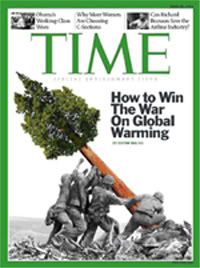 Some related reading:
- For the whacked-out MSM view calling for a complete retooling of the economy a la WWII to
tilt at windmillsfight global warming, read this essay in Time. - For a counterpoint, read this essay by Dennis Prager, who says, "It is much easier to fight global warming than to fight human evil."
- For a much more logical approach than Time's, in which we apply technology to conserve, rather than appease the hysterics, see this essay by Glenn Reynolds in the NY Post.
Labels: Earth Day, Environment, Environmentalism, Free markets, Global warming
posted by Laer at 5:39 AM
|