Cheat-Seeking Missles

Tuesday, June 24, 2008

Tortured Questions

I expect my government to be truthful, but I've got constructive knowledge that government can lie or spin.

Constructive knowledge is defined by lawyer Steve at Binjo Ditch as, "the type of knowledge that one using reasonable care or diligence should have, and therefore is attributed by law to a given person." I've lived through the Clinton years and the Nixon years, so I have constructive knowledge that even the U.S. government can lie.

That hardly makes me a wild conspiracy theorist. I certainly have given the Bush admin the benefit of the doubt, for a number of reasons. First, my own constructive knowledge tells me that the left has exaggerated, trumped up and outright fabricated criticisms against Bush and the war. Most of these accusations of lying are easily disproved, as is the case with "Bush lied, people died" on WMDs. So constructive knowledge reassures me that many of those making the claims are hardly credible; they're ranters, negative beings, BDR sufferers. Here's a good case in point. And finally, Bush just always struck me as an admirable, Christian man who wouldn't put up with lying. Call me naive; it's just been my impression.

Constructive knowledge also tells me that members of al-Qaeda and other jihadists will lie, and indeed are encouraged to lie, about being tortured while being held captive by American forces. They're trained to do it and the Koran encourages them to do it, and it's important to keep that in mind as we proceed.

So, who's lying in this case:
WASHINGTON (AP) - Medical examinations of former terrorism suspects held by the U.S. military at Abu Ghraib prison in Iraq and Guantanamo Bay, Cuba, found evidence of torture and other abuse that resulted in serious injuries and mental disorders, according to a human rights group.
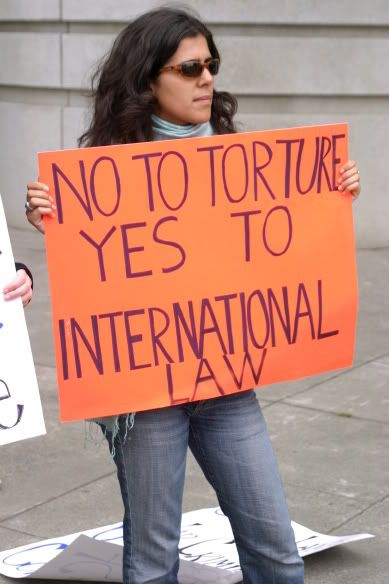
The story from last week -- which of course I can't risk clipping more from, given AP's recent strict enforcement of its copyrights -- goes on to describe what was found in medical examinations of 11 former Guantanamo and Abu Ghraib detainees. Most shocking are allegations (supported, according to the report, by evidence of burns on thumbs) of electric shock, and of sodomization. (The latter charge was not substantiated, as the accuser would not allow an inspection of his private parts.)

Is my country lying to me, to us, about its policies on torture? Or is the human rights group? Or are the former detainees?

Arguing for the latter two is the timing of the release of the report, just as the (Dem-dominated) Senate Armed Services Committee began looking into warnings from military lawyers to the Pentagon regarding the possible illegality of some interrogation measures. Timing like this is often a sign that a study's been trumped up.

Arguing that interrogation techniques went beyond what we were told and what I personally would accept are the wear and tear caused by the endless stream of reports, and these latest reports, and my cognitive knowledge that the reported incidents at Abu Ghraib were, in fact, abominable.

Arguing against that is the nebulous qualities of the human rights group's report. Some of these detainees have been out of our control for a number of years, and all of them were living lives before they were detained. There's no way of knowing if their injuries occurred while under US control -- if they occurred at all. And that guy wouldn't pull down his pants to allow an examination.

Also on point is the fact that some of the alleged "tortures" are mere miscomforts suitable for the interrogation of enemy: sleep deprivation, stress positions, cold, heat, hunger. Sorry, but this is not about redefining torture; it's about whether torture -- being shocked or sodomized, for example -- occurred.

Arguing for concern that it might just be true is the committee's report on the lawyer's findings. Binjo Ditch summarizes the whole deal:
When military lawyers warn the Pentagon that interrogation techniques they are looking into may be illegal, then the DOD should know that they need to tread carefully, and to look into the legality of the issue, rather than dive in with reckless disregard for the law.
To which Lindsey Graham replied (paraphrasing here for AP's sake), "Bunk! It was just an irresponsible and shortsighted job by the lawyers!" I would normally say we have a he said/she said here, and that I'm biased to trust the government over the accusers, but Graham made an odd choice of words that's troubling. Had he used "wrong and deliberate," he would have communicated one thing (like the most recent National Intelligence Estimate on Iran), but he chose "irresponsible and shortsighted," which communicates something entirely different.

In the end, we must look for known facts, and that causes us to dismiss the human rights group's report because it is just too unsubstantiated. That leaves the Pentagon lawyers, the interrogators and those being interrogated.

Without knowing the Pentagon lawyers, my constructive knowledge tells me staff at State and the CIA have gone out of their way to throw up challenges and embarrassments to the administration, so I can't reasonably say the Pentagon staff would be any different. Their warnings appear to me to be part good and part reliant on a BDS definition of torture.
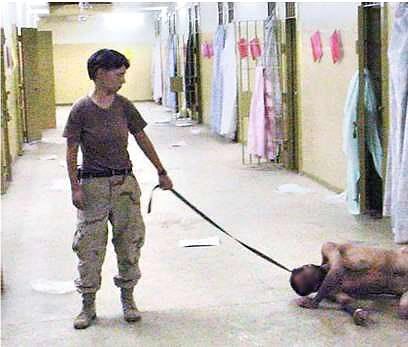
As for the interrogators, we rightfully don't know much. If their techniques were common knowledge, the enemy could train themselves to deal with them. But we do know this: Every interrogator knows the rules; they're clearly written. And every interrogator does not want to be the next Lynndie England, exposed, shamed and convicted.

That leaves the detainees, who constructive knowledge tells us have been trained to allege torture. In the end, this is the only rock-solid piece of evidence in the entire story. All we can say for certain out of all of this is that despite what the Pentagon lawyers said, despite what the interrogators have said, the only provable fact out of the whole pile is that detainees lie.

So, uncomfortable as this entire matter made me about what my country's up to, it must remain just that: a discomfort, a confusing addition to my constructive knowledge. In the end, it changes nothing.

Labels: , ,

Wednesday, April 02, 2008

Yoo Interrogation Memo Paranoia

Marty Lederman, writing at the blog Balkanization, has his hands on, as he so objectively calls it, "The Big Kahuna: The Torture Memo that Makes the August 2002 Memo Look Like Objective and Thoughtful Legal Analysis."

This is the "notorious" memo ... well, allow me to let Lederman describe it:
On Friday, March 13, 2003, Jay Bybee resigned from his Office as the Assistant Attorney General for the Office of Legal Counsel, to become a judge on the U.S. Court of Appeals for the Ninth Circuit. The very next day -- a Saturday, mind you -- John Yoo, merely a Deputy AAG in the Office, issued his notorious memo to the Pentagon, on behalf of OLC, which effectively gave the Pentagon the green light to disregard statutory limits on torture, cruelty and maltreatment in the treatment of detainees.
The paranoid implication here is that Bybee read the memo, wouldn't sign it, was forced out, and Yoo issued it. There may be some level of truth there; there may not. But the override here is that Bybee left not because of a tiff over a memo, but to become a U.S. Court of Appeals judge, a position that doesn't exactly open up over night. He was not forced out; his departure date was known long in advance.

And the 81-page memo is hardly something that could be whipped up overnight. (I know that's not part of the passing hysteria here, but Lefties quick to conspiracy theories will take it there, trust me.)

Lederman goes on to say,
Needless to say, the classification of these memos all these years was ridiculously unjustified. There's no reason at all that this roll out could not have occurred in 2004.
Needless to say? Really? You've read all 81 pages and can say that with certainty? You can't see any scenario whatsoever that would allow the classification of a document that discusses at length what may and may not be legal when interrogating enemy combatants? Nothing at all that might not give the enemy combatants a wee edge against our forces?

To the American Left, conspiracy is a one-way street: America is capable of all the evil in the world; our opponents and enemies are capable of none of it.

Lederman also calls the memo "the blueprint that led to Abu Ghraib," hyperbole on a par with Obama's endless incorrect parsing of McCain's "100 years in Iraq" statement. We all know that Abu Ghraib's perps followed no blueprint and were summarily punished for their renegade actions, and Lederman's insistence at blaming Bush for what happened there befouls every other argument he makes.

As for the memo itself, it is thorough and comprehensive, the work of a government trying hard to figure out the legal limits of working with stateless terrorists bound by no legal limits.

Here's just a taste of that thoroughness, from the introduction:
In Part I, we conclude that the Fifth and Eighth Amendments, as interpreted by the Supreme Court, do not extend to alien enemy combatants held abroad. In Part II, we examine federal criminal law. We explain that several canons of construction apply here. Those canons of construction indicate that federal criminal laws of general applicability do not apply to properly~authorized interrogations of enemy combatants, undertaken by military personnel in the course of an armed conflict. Such criminal statutes, if they were misconstrued to apply to the interrogation of enemy combatants, would conflict with the Constitution's grant of the Commander in Chief power solely to the President.

Although we do not believe that these laws would apply to authorized military interrogations, we outline the various federal crimes that apply in the special maritime and territorial jurisdiction of the United States: assault, 18 U.S.C. § 113 (2000); maiming, 18 U.S.C. § 114 (2000); and interstate' stalking, 18 U.S.C. § 2261A(2000). In Part II.C., we address relevant criminal prohibitions that apply to conduct outside the jurisdiction of the United States: war crimes, 18 U.S.C. § 2441 (2000); and torture, 18' U.S.C. § 2340A (2000 & West Supp. 2002).

In Part III, we examine the international law applicable to the conduct of interrogations. First, we examine the U.N. Convention Against Torture and Other Cruel, Inhuman, or Degrading Treatment or Punishment, Apr. 18, 1988,1465 D.N.T.S. 113 ("CAT") and conclude that U.S. reservations, understandings, and declarations ensure that our international obligations mirror the standards of 18 U.S.C. § 2340A. Second, we address the U.S. obligation under CAT to undertake to prevent the commission of "cruel, inhuman, or degrading treatment or punishment." We conclude that based on its reservation, the United States' obligation extends only to conduct that is "cruel and unusual" within the meaning of the Eighth Amendment or otherwise "shocks the conscience" under the Due Process Clauses of the Fifth and Fourteenth Amendments.

Third, we examine the applicability of customary international law. We conclude that as an expression of state practice, customary international law cannot impose a standard that differs from U.S. obligations under CAT, a recent multilateral treaty on the same sUbject. In any event, our previous opinions make clear that customary international law is not federal law and that the President is free to override it at his discretion.

In Part IV, we discuss defenses to an allegation that an interrogation method might violate any of the various criminal prohibitions discussed in Part ll. We believe that necessity or self~defense could provide defenses to a prosecution.
This is not the work of an administration, as portrayed by the braying donkeys on the Left, that is riding roughshod over human rights. It is, rather, the work of an administration that is rigorously seeking appropriate guidance in a thick forest of often conflicting laws, regulations, treaties and court decisions.

It is also the work of an administration that knows it has to deal with enemies besides the ones who bow to Mecca daily -- it is an administration that anticipates and plans for attacks from the ACLU; various Soros-funded activist groups; Harry Reid, Chuck Schumer and a Congress-full of other anti-Bush, agenda-driven electeds; activist judges, and paranoid bloggers.

Of course, unaddressed by Lederman or his colleagues is anything about the nature of the enemy, anything about the nature of the interrogation procedures that actually have been used, or any analysis of benefits vs. cost of the administration's policy on the interrogation of foreign enemies intent on killing us.

But then, being a leftist has never required being rational.

Labels: , , ,

Friday, February 16, 2007

Graham Ambushed By Ex-Abu Ghraib CO

Elanor Clift, fresh from calling global warming deniers akin to holocaust deniers, jumped at the opportunity to attend the opening of the Kennedy-Krafted (Rory, RFK's daughter, born six months after his assassination) film "Ghosts of Abu Ghraib." I amost didn't read the article ... but I was in the mood for a little righteous indignation at leftyscribes. I had a couple pleasant surprises.

After the usual Clift-clatter ...
The administration’s war policies are like a Band-Aid slowly being pulled off. The lies, the faulty intelligence, the recriminations, and now—thanks to a new documentary by filmmaker Rory Kennedy, “The Ghosts of Abu Ghraib”—the spotlight is back on the infamous prison where revelations of abuse and sexual humiliation destroyed what was left of America’s moral high ground.
... came this very interesting passage:
[Ted] Kennedy called the investigations into what happened at Abu Ghraib “a basic whitewash” because no high-ranking officials were held accountable. [Lindsey] Graham said the abuses were not systemic, that this was “sadism on the night shift,” and it was up to the commander on the ground to keep the young soldiers in line.

To Graham’s evident surprise, the commander was in the audience. Brig. Gen. Janis Karpinski rose to her feet to challenge Graham’s assertion that she should have been court-martialed. With her gray hair pulled tight into a bun and wearing a soft-gray knit suit, she lit into Graham, saying, “I asked for a court-martial. They didn’t want me in a courtroom because they didn’t want to hear the truth.”

Karpinski was demoted in rank but did not serve jail time. In the film, she talks about “begging” for resources to handle what had become “a huge mass of humanity thrown into a mud pit.” Abu Ghraib, by September 2003, housed 6,000 prisoners and had only 300 military police guarding them.

Graham sputtered a bit at being sandbagged, but was unmoved.
What a moment that must have been! I don't have a lot of sympathy for Karpinski, but putting a self-aggrandizing old coot like Graham on the spot ... well, bully for her.

Clift also actually put some decent perspective in this piece, noting:
Thirty thousand people were executed at Abu Ghraib during Saddam Hussein’s regime, most of them hung from huge meat hooks. The hooks are still there in the film; pictures of Saddam still adorn the walls. Wild dogs roam the grounds trying to dig up the dead.
Thirty-thousand dead -- mostly the victims of political murders or ethnic cleansing -- in just one popular Saddam venue, and the Left howls about the unrighteousness of our cause, including writers like Clift.

hat-tip: Real Clear Politics

Labels: , , ,