Cheat-Seeking Missles

Wednesday, March 21, 2007

VDH Gives 300 An A

Historian Victor Davis Hanson answers the critics who say 300 was propaganda: distorted and unfactual.

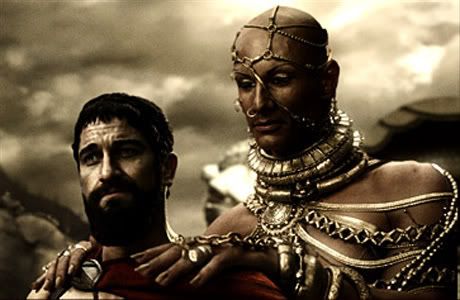
His answer: The story of a handful of Greeks holdling of tens of thousands of Persians is a true story, even if drawn in comic book style -- like the metrosexual Xerxes above. The Persian king, according to historical records, was no sissy boy.

And yes, the Greeks were more like us and were the good guys, and the Persians were more like the Islamists and were the bad guys.

Hat-tip: Real Clear Politics

Labels: ,

Wednesday, March 14, 2007

Of Spartans And Being Spartan

If you want some very intersting reading, see what
Let me address the main point [of another commenter. Was Spartan society a terrible one? No, it was not.

Why wasn't it? Because not every society is going to match your individual specifications and engineering requirements. You are not God, societies are made up of all the people in it, and of the traditions of those that have gone before. You will never 100% like your society. Hell, Americans don't 100% like their society. It's just the reality, deal with it.

The standard used to judge the relative worth of a society then should be based upon justice, goodness, order, and law. Virtues so to speak, equivalent to Aristotle's virtue theory.

The martial virtues were very present in Sparta's world. Courage, bravery, valor. The ability to shirk pain and to surpass it. Remember, this was the day before electricity people. Muscle power dominated.

Unless you wanted your city and people sacked, mutilated, cut up, and torn apart to feed the dogs... you will train an elite force of protectors. ...

And guess what. Islam treats women probably worse than the Greeks ever did back in ancient times. Same would go for Persia. All those slave girls and comfort battalions of women trailing the Persian army.

So they were fighting against Sparta (US Marines), who gave their women freedom and worth... hardy har har.

Labels: , , ,

Saturday, March 10, 2007

Troop Shortage? I Have A Solution

The MSM are reporting troop shortages in Iraq. I don't believe it.

The gist of the coverage is that some brigades will have to stay longer and some will have to deploy sooner to meet the troop levels needed for the surge. But that's been the plan since the outset -- it's not news. Faced with victories even before the surge takes hold, the media is scrambling for bad news, and has presented standard troop management as bad news.

No surprise there, so let's move on.

Even if MSM are exploiting the situation in their never-ending quest for negativity, given the situation we're in, it's pretty obvious that this world calls for more troops, not fewer.

How are we going to get more troops if every day the news is full of news of defeat, of injuries poorly treated, of discouragement and blackness and doom. Not exactly the stuff that drives guys down to the Recruiters to sign up.

Enter 300.

Speaking for the anti-war Left, Slate columnist Dana Stevens laments that it's just too gung ho -- too much brotherhood among the Spartans, too much sickness among the Persians, too much heroism and willingness to sacrifice for what's right. Too much clarity about who's right and who's wrong.

I saw the movie yesterday afternoon, and it has all of those things, and too much of none of them.
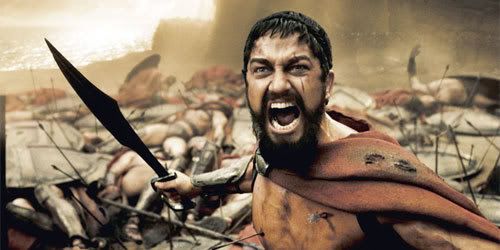
300 is a rousing, bloody, victorious celebration of men fighting for their country and famiies against an enemy that is strong, intimidating and evil. The parallels with today are profound. The Spartans fought for freedom against a society that preferred repression. They fought against "mysticism" that came with Persia, a codeword for Islam, even though Islam did not exist at the time.

The 300 Spartans also fought against anti-war sentiments at home, despite Stevens' myopic claim that there wasn't an anti-war theme in the movie. And in 300's presentation, one side in the anti-war debate is right and one side is wrong -- guess which is which.

There were a lot of young guys in the theater with me, and they dug the movie. A lot. While 300 alone might not drive recruits into the military, it certainly won't turn the spigot further off.

Now, how about a movie about our soldiers in Iraq that isn't all muddied with negative questions and misrepresentations, a movie that just shows good guys kicking bad guys butt?

Propaganda, you say? No way. Every day, good US soldiers are fighting the good fight against really bad guys in Iraq, living in real life screenplays for really amazing movies.

Surely somewhere in Hollywood there's a renegade production company with the courage to stand up to the establishment and make contemporary, pro-American war movies.

Labels: , , ,

Friday, March 09, 2007

Left Doesn't Like 300 Any More Than 24

Shame, shame on the directors and producers of 300 for telling the story of the heroic stand by 300 Spartans at Thermopylae to hold back hundreds of thousands of Persians intent on conquering Greece -- and with it the seeds of Western civilization.

We should not honor this bravery, they say, we should ignore this heroism to protect the Greek city states, with their emerging democracy, against those who would crush them and impose slavery.

No really, it's true. Here's Dana Stevens, writing today in Slate:
If 300, the new battle epic based on the graphic novel by Frank Miller and Lynn Varley, had been made in Germany in the mid-1930s, it would be studied today alongside The Eternal Jew as a textbook example of how race-baiting fantasy and nationalist myth can serve as an incitement to total war. ...

The comic fanboys who make up 300's primary audience demographic aren't likely to get hung up on the movie's historical content, much less any parallels with present-day politics. But what's maddening about 300 (besides the paralyzing monotony of watching chiseled white guys make shish kebabs from swarthy Persians for 116 indistinguishable minutes) is that no one involved—not Miller, not [director Zack] Snyder, not one of the army of screenwriters, art directors, and tech wizards who mounted this empty, gorgeous spectacle—seems to have noticed that we're in the middle of an actual war. With actual Persians (or at least denizens of that vast swath of land once occupied by the Persian empire).

In interviews, Snyder insists that he "really just wanted to make a movie that is a ride"—a perfectly fine ambition for any filmmaker, especially one inspired by the comics. And visually, 300 is thrilling, color-processed to a burnished, monochromatic copper, and packed with painterly, if static, tableaux vivants. But to cast 300 as a purely apolitical romp of an action film smacks of either disingenuousness or complete obliviousness. One of the few war movies I've seen in the past two decades that doesn't include at least some nod in the direction of antiwar sentiment, 300 is a mythic ode to righteous bellicosity. In at least one way, the film is true to the ethos of ancient Greece: It conflates moral excellence and physical beauty (which, in this movie, means being young, white, male, and fresh from the gyms of Brentwood).
To please Stevens and the raving anti-war, anti-West, anti-American Left, Snyder would have had to:
  • Integrate anti-war sentiments into a story where there were no anti-war sentiments. It was win or die and everyone knew it.
  • Make all the actors similar in color, stature, profile, hair color and sympathetic qualities.
  • Include a secondary plot within the Persian ranks that makes us sympathetic to this army intent on conquering, raping and pillaging.
  • And finally, just not make the film at all since it glorifies war and says civilization and democracy are worth fighting for.
The war fought at Thermopylae, which Stevens discounts as "classical history and legend," was the first of many wars that made it possible for Stevens to be Stevens today -- writing freely, dodging any defense of country, happily unfettered and Western. Pity anyone should glorify it.

Stevens just can't have any fun at all. He looks at the film's portrayal of Persians and sees World War II films' portrayals of Japs and Krauts:

Here are just a few of the categories that are not-so-vaguely conflated with the "bad" (i.e., Persian) side in the movie: black people. Brown people. Disfigured people. Gay men (not gay in the buff, homoerotic Spartan fashion, but in the effeminate Persian style). Lesbians. Disfigured lesbians. Ten-foot-tall giants with filed teeth and lobster claws. Elephants and rhinos (filthy creatures both). The Persian commander, the god-king Xerxes (Rodrigo Santoro) is a towering, bald club fag ["Fag?!" Isn't that short for something?] with facial piercings, kohl-rimmed eyes, and a disturbing predilection for making people kneel before him.

Sounds like standard issue comic book villains. If Stevens is "disturbed" by Xerxes' fixation on demanding subjects kneel before him, I doubt if he could stomach the routine tortures and corporal punishments of the day.

Stevens doesn't care much at all for the Spartans:

Meanwhile, the Spartans, clad in naught but leather man-briefs, fight under the stern command of Leonidas (Gerard Butler), whose warrior ethic was forged during a childhood spent fighting wolves in the snow. Leonidas likes to rally the troops with bellowed speeches about "freedom," "honor," and "glory," [Why the quotes? Are those concpets not real?] promising that they will be remembered for having created "a world free from mysticism and tyranny." (The men's usual response, a fist-pumping "A-whoo! A-whoo!" sounds strangely fratty.)
And worst of all, here at the dawn of Eurocentric history, Leonidas did not follow the rules of war set down in Geneva (forget the fact that if there hadn't been a Greek victory at Thermopylae, there wouldn't have been a Geneva):

When a messenger from Xerxes arrives bearing news Leonidas doesn't like, he hurls the man, against all protocol, down a convenient bottomless well in the center of town. "This is blasphemy! This is madness!" says the messenger, pleading for his life. "This is Sparta," Leonidas replies. So, if Spartan law is defined by "whatever Leonidas wants," what are the 300 fighting for, anyway? And why does that sound depressingly familiar?

Stevens would have cancelled production on all the great movies of World War II, and John Wayne and his buds would have been waiting tables instead of playing valiant sailors, soldiers and Marines. Worse, he would have called for movies that showed the soft, nice side of Japs and Krauts, made the troops watch them and hope for crushed morale.

Is it no longer OK to have a romp that has good guys and bad guys ... and lets us be the good guys? Apparently Stevens and many like him think so. They want Hollywood to stay in its critical, anti-American mode, and will attack 300, 24 or any other production that dares to defend the concept that civilization, whether American or Greek, beats repression any time and is worth defending.

hat-tip: memeorandum

Labels: , , ,